The Newer Map
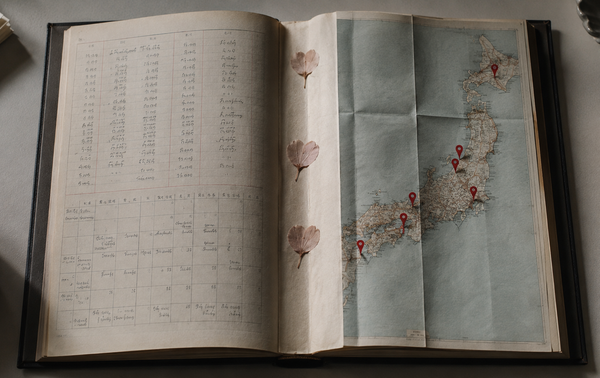
My mother arrived from China and started keeping a ledger of American life: what capital can build quickly, and what only time can. Four months later, I realized which of us had stopped updating our map.
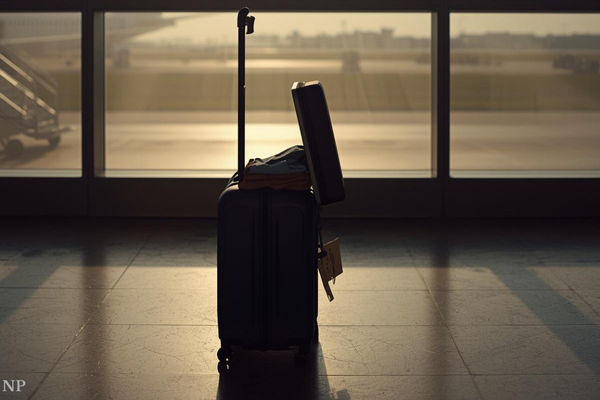
My mother has landed at Dulles enough times to stop comparing it to Beijing. She made her peace with it years ago. America, she decided, simply holds its airports to a different standard.
This time she noticed something new. Nothing had changed at Dulles. Something had changed at home.
We loaded her suitcases into the trunk and pulled up to the exit. My husband rolled down the window and fed his credit card into the slot. The machine considered it. The gate considered it. Then it lifted, and we drove through, leaving a sizable line behind us.
"You still do it this way?" she asked.
At home, she explained, you don't stop. A camera reads the plate, or you scan a code, and the gate is already rising. The card, a small plastic rectangle handed to a machine through a car window, belongs to another time. She doesn't live in Shanghai or Shenzhen. She lives in Changsha, a provincial capital in central China.
We had paid for parking this way hundreds of times. I complained nearly every time: the wait, the awkward lean out the window toward the card reader. But I had never once thought it should belong to another time.
Almost twenty years ago I left China for the country where the future seemed to live. Now my mother sat behind me, fresh off a fourteen-hour flight, watching us pay for parking the way people did the year I left. I was a little embarrassed.
The Map That Stopped
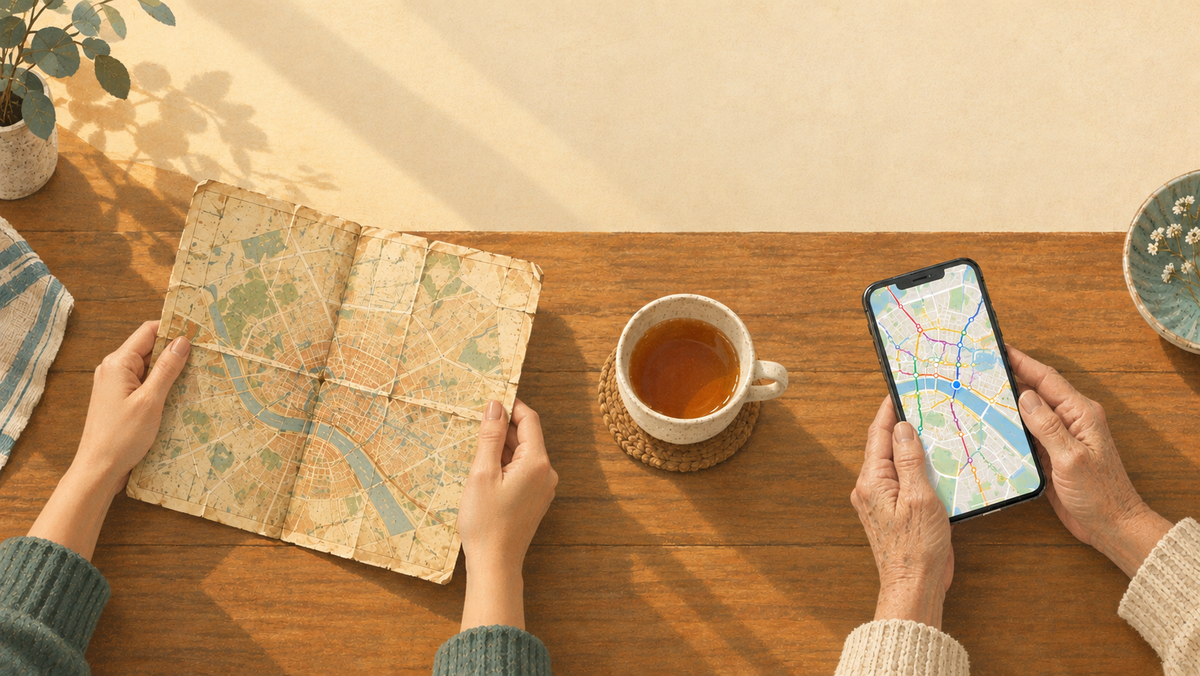
Every emigrant carries a map of home, and the map stops updating on the day you leave. Linguists have a name for one version of this. They call it colonial lag: transplanted communities hold on to older words and customs while the place they left keeps moving.¹ I had always assumed it described other people. The cousin's dated slang. The uncle's frozen idioms. It had not occurred to me that it described my picture of an entire country.
My China is roughly a 2007 China. That year, a little under half the population lived in cities. Today it is about two-thirds.² The country's first true high-speed rail line opened shortly after I left. By the end of 2024 the network stretched to roughly 48,000 kilometers. I learned about these changes from the morning news on my commute. My mother lived inside them. She thinks nothing of a day trip to Guangzhou, more than 400 miles away, because the fastest train now makes it in about two hours.³ The Korean sociologist Chang Kyung-Sup calls what societies like hers went through compressed modernity: transformations that took the West centuries, packed into decades.⁴
She is a veteran of compression. My map is a museum piece.
So for the first few weeks, the old immigrant script ran backward in my house. In that script, the newcomer arrives looking up at America and spends years catching up. I arrived on that script. My mother, older than me by a generation, arrived on a newer one. She was the visitor, and I was the one behind.
But what she kept was not a scoreboard. It was a ledger — item by item, unsentimental, in two columns it took me most of her visit to understand. One held what capital can build quickly. The other held what only time can.
Part 1: What You Can Build in Years
The first column filled quickly.
It started with dinner on her first night. She watched me pay a delivery fee and a tip for an Uber Eats order that was delayed, delayed again, and finally canceled because the app couldn't find a driver at peak hour. At home: thirty minutes, no fee, food piping hot. Then she unpacked a suitcase of pajamas, socks, and building toys for the grandkids. She had seen the equivalents on Amazon, made in China, priced at several times what she pays at home, at a quality she wouldn't accept there. Frozen maps, it turns out, run in every direction. Many Americans still read "made in China" as cheap. My mother knows the better goods often stay home.
It didn't stop there. The bumpy streets. The highway dividers, overgrown with weeds. At home, she said, they are manicured flower beds.
Then came a storm. We drove through an intersection where the traffic light had gone dark. A falling branch had brought down a line on our street, I explained, and it could take hours for the utility trucks to fix it. “Why do the wires hang in the air at all?” she asked. In Changsha, she said, you hardly see them overhead anymore. Here, only about 18 percent of the distribution grid is buried, partly because burying a line can cost five to ten times as much per mile as stringing it overhead.⁵
It would be easy to read this column as a story of decline. The economic historian Alexander Gerschenkron offered a better reading. Countries that develop late, he argued, don't have to retrace the path of those who went first; they can skip stages and adopt the newest tools directly.⁶ America strung its wires and built its parking gates early, and now lives with them. China built later, and built newer. Much of my mother's first column is a story about timing, not talent.
The column also has a hidden ledger of its own. Thirty-minute delivery runs on riders racing algorithms that keep shaving minutes from their routes. In 2020 the Chinese magazine Renwu showed how that pressure pushed riders into traffic violations and a rising number of accidents.⁷ The free part of free delivery is paid by someone.
Her ledger first widened on our daily walk after dinner.
After dark in her community, the concrete walking paths that snake around the apartment buildings fill with children on bikes and elders strolling, with hardly a quiet corner left for conversation. After dinner in mine, we followed the path into the preserved woods behind our backyard and came back from an hour-long walk having seen almost no one.
She was astonished by the woods — all that green, all that space, right outside the door. She was baffled by the emptiness. Her verdict: Americans are lazy.
I defended them. These are working parents, I said. Two careers, kids, homework, inboxes. At seven o'clock, nobody has the energy for a walk.
It took me a moment to notice I was describing myself. On any evening she wasn't there, I would still have been scrubbing pots at that hour. The only reason I was on that path at all was that my mother had cooked dinner.
The data suggests I'm typical. Americans aged 35 to 44 have less leisure time than any other age group, under four hours a day, and on an average day only about one American in five does any sport, exercise, or recreation at all.⁸ We have the woods. We don't have the evenings. Her neighborhood, crowded and paved, has the reverse, and not because people there work less. Look closely at that evening crowd and it is mostly grandparents and grandchildren. In China, the help often lives under the same roof, and so does the time.
Part 2: What Takes a Generation
The boys opened her second column. Raising a child is the one project that takes a generation in any country.
She was charmed by the yellow school buses at the end of the street, and stunned when I told her that public school through twelfth grade costs nothing, with free or discounted lunches for families who need them. She loved browsing the children's shelves at the county library, amazed that we could carry home a stack of books with nothing but a library card and a self-checkout kiosk.
Then came the bills for everything we had chosen to add on top. She added up what we were paying for the boys’ private school tuition, piano, art, and swimming lessons, after-school programs, and summer camps. “You could buy a few apartments in China with this!” She was genuinely shocked. In Maryland, private school tuition averages more than $16,000 a year, and nearly $30,000 at the state's established independent schools; on top of that, the average family with a child in sports spends over $1,000 a year on that child's main sport alone.⁹
Lay those two lists side by side and a pattern appears. In America, almost anything that requires a person's time is expensive, and almost anything held in common is cheap. The library, the bus, the woods: nearly free. Smaller classes, one-on-one lessons, anything that happens outside regular school hours: priced like luxuries.
It would be tempting to say the prices simply run the other way in China. They don't. Scaled to the size of each economy, China is one of the most expensive places in the world to raise a child: getting one to eighteen costs about 6.3 times GDP per capita, against about 4.1 times in the United States.¹⁰ Chinese parents pay, and pay heavily. What differs is who supplies the time. In America we buy it from coaches, tutors, and camps. In China, much of it still comes from grandparents, unpaid, at home; one multi-province survey found that more than six in ten families rely on grandparents to help raise their children.¹¹ For four months, it came from my mother.
Prices are a dashboard of what a society finds scarce. In America, the scarcest thing is the same thing missing from the path behind my house at seven o'clock: time.
And "free" public school is not free. Most American families pay for it through where they can afford to live: the house, the school zone, the property tax bill. In China the same invoice has a name, xuéqūfáng, the school-district apartment. Some lines in the ledger read the same in both languages.
Part 3: What Takes a Century
In the last month of her stay, we drove eleven hours to Maine. The roads were rougher than she's used to. She didn't seem to mind.
She was excited about Acadia. “There isn't much untouched nature left back home,” she told me. It's an overstatement, but I knew what she meant. What she has watched multiply instead is a newer kind of attraction: the freshly built "ancient town," with pavilions, ramparts, and cobbled lanes assembled in a few years. Some thrive. Some don't. She has stopped going back to Zhangjiajie, Hunan’s crown jewel, famous for its towering natural sandstone pillars. There, a faux-ancient district that reportedly cost more than 2.2 billion yuan was completed in 2021 and has sat largely empty, its developer pushed into restructuring.¹² Someone built a fake old town at the foot of real ancient mountains.
You can build an ancient town in a few years. You cannot build an old one.
Acadia is old in the way that matters. We biked the carriage roads that John D. Rockefeller Jr. financed between 1913 and 1940: some 45 miles of broken-stone road and hand-built stone bridges, laid by local masons and Italian immigrants, and maintained today with help from an endowment created in 1995.¹³ Immigrants laid the road. A century of strangers has kept it.
The scenery awed her: the bare granite summit of Cadillac Mountain, the lichens, the low shrubs heavy with red berries. But what moved her most was the people.
There was the woman who guided her canoe through the marsh. She had led those tours for decades, knew every bird, fish, and plant by name, and pulled up a sprig of goose tongue greens for my mother to taste. There was the lobster boat crew who had run the same cruise for years, showing her how to measure a catch and patiently explaining why they throw back the breeding females, the young, and the oversized males. What they had in common, I realized, was that they had stayed: decades in one place, doing one thing, until they knew it completely. My mother stayed too.
Then there were the vacationers, biking, swimming, hiking, and sweating their way through the park. It was a sharp contrast to the dǎkǎ (打卡) culture she sees at home, where people travel to a trending spot, eat the famous dish, or finish the activity mostly to post proof that they were there. “America has its own version,” I told her. “We call it Instagram, and now TikTok.”
“At least the parks stayed for those who still want them,” she said.
And there was the cleanliness. Miles of trails without litter. Toilet paper even in the portable toilets at the trailhead. Someone stocks it. Nobody takes it.
Hardly any of it is enforced. A park stays that clean because millions of visitors share an unspoken agreement to leave it as they found it. No one can build that agreement with capital, on a deadline. It accumulates.
“We built the roads,” she said. “Here I found what nature used to look like.”
At the departures curb at Dulles, she refused the luggage cart.
Seven dollars, the machine said. She read it with the same polite disbelief she had given the parking gate on the day she arrived, and turned away. “With that money, I could pay someone to carry my luggage in China!” she said. At home the carts wait in rows by the doors, free.
So we dragged her two suitcases and a carry-on across the lanes toward the terminal. In front of us, she walked with a grandson's hand in each of hers, at her own pace, which is not fast.
Nobody honked. A shuttle bus stopped. Then an SUV, then the car behind it, engines idling, every driver waiting for a 62-year-old woman, two boys in tow, who had just declined to pay for help.
She looked up and waved at them with a big smile, a small open-handed thank-you she had not owned when she arrived four months earlier. She had picked it up here, the way she picks up everything: by watching.
She flew home with one new habit. I stayed behind with a newer map.
End Notes
- The term "colonial lag" was coined by linguist Albert Marckwardt in 1958; later linguists (e.g., Görlach, 1987) have challenged how far it holds for language, so it is used here as a metaphor. Rohdenburg & Schlüter (eds.), One Language, Two Grammars?, Cambridge University Press, 2009.
- World Bank, World Development Indicators: China's urban population was 45.9% in 2007 and 65.9% in 2024 (China's National Bureau of Statistics reports about 67% for 2024).
- China's first dedicated high-speed line, Beijing–Tianjin, opened in August 2008; the network reached about 48,000 km by the end of 2024. Travel Tomorrow, citing China State Railway Group. Changsha South to Guangzhou South in 1 hour 59 minutes since June 2024: People's Government of Hunan Province.
- Chang Kyung-Sup, The Logic of Compressed Modernity, Polity Press, 2022.
- Grid Underground Distribution Statistics, arXiv 2402.06668 (2024); Stanford Doerr School of Sustainability, October 2025.
- Alexander Gerschenkron, Economic Backwardness in Historical Perspective, Harvard University Press, 1962.
- Renwu (People), "Delivery Riders, Trapped in the System," September 8, 2020; see also Carnegie Endowment, "How Food Delivery Workers Shaped Chinese Algorithm Regulations," November 2022.
- U.S. Bureau of Labor Statistics, American Time Use Survey, 2024 results; The Economics Daily, September 15, 2025.
- Private School Review, Maryland private school averages, 2026–27 (statewide average tuition $16,385; Association of Independent Maryland and DC Schools members, $29,863); Aspen Institute Project Play youth sports parent survey, as reported by Northwestern Mutual.
- YuWa Population Research Institute, China Childbirth Cost Report 2024, as reported by CNN and The Guardian, February 21, 2024.
- Frontiers in Public Health (2024), citing a 2016 survey of parents across more than ten provinces: 61.6% of families rely on grandparents for child-rearing support.
- Sixth Tone, "They Built an Entire 'Ancient Town.' Practically Nobody Came," November 22, 2024.
- National Park Service, "Acadia's Historic Carriage Roads" and "Bike Carriage Roads"; The Cultural Landscape Foundation.