
The Dream Vacation I Keep Not Taking
Nine months of planning, a Google Maps folder full of pins, a week blocked on the calendar since June. Then we drove to Philadelphia instead — and the folder is still in my phone.
The Folder
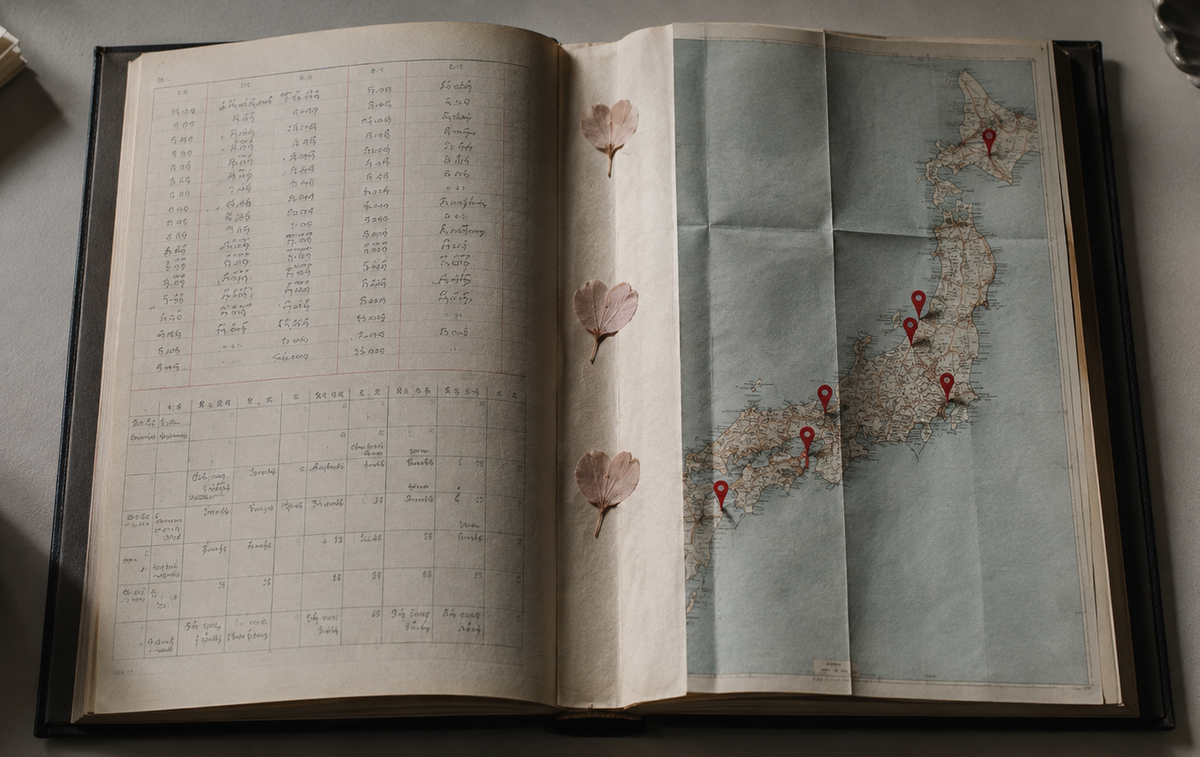
There is a folder in my Google Maps named "Spring Break JP Adventure." It holds every pin a family of four could need for one week in Japan at the end of March: the ramen counter and the takoyaki stand in Osaka that seat children without ceremony, Odaiba in Tokyo, where you cross the Rainbow Bridge to find a giant Gundam and a replica of the Statue of Liberty, the ryokan in Hakone that welcomes kids into the hot spring and builds them their own meal course so the adults can enjoy the kaiseki in peace.
The folder was not an impulse. I built it the way I build anything — thoroughly, and early. The school released next year's calendar in June; I blocked the week in my work calendar the same day, nine months out. I priced the flights. I shortlisted the hotels. My husband and I kept a shared note that grew all fall — a running list of things the boys would love, food we refused to leave without trying, and of course the Japanese skincare and makeup products I swear by. By winter, the trip existed in every system I own. Calendar, maps, notes. Everything but a booking confirmation.
The end of March is the only time this trip can exist. The boys are off school. Japan is in bloom. The window is narrow and it is beautiful and it comes exactly once a year.
It is also Q1.
The same nine months that let me plan the trip let me watch the collision approach: the cyclical business planning, the deliverables that stack into late March the way they stack into late March every year. Taking the week would have meant compressing a month of work into the weeks on either side of it — the preparation before, the pile waiting after — plus the trip itself, a foreign-country itinerary for four, compounded by fourteen hours of direct flight and a thirteen-hour time difference, running as one more workstream on top. I did the math the way I do all math — except this time, imagining the logistics was more exhausting than running a ten-year forecasting model. Then we backed out.
We drove to Philadelphia instead. I booked the hotel the week before. No fighting for reservations that open only in some precise booking window — just a loose itinerary with a few must-sees and plenty of free time in between. No memorizing fellow travelers’ tips for navigating a quirky transit system — just the comfort of knowing Philly is another town a few hours down the road, with all the boys’ stuff packed in the car. The boys climbed through the gigantic USS Olympia and pressed every button in the Franklin Institute. Dinner was takeout in the hotel room after full days of city exploration — nothing gourmet, but full of the little treats the boys don’t usually get at home. It was, by any honest account, a good trip.
The folder is still in my phone. I have not deleted a single pin.
In Defense of Philadelphia
Let me make the sensible case first, because it is real.
Philadelphia was the right call. Any parent who has flown fourteen hours with children understands that a trip is not measured only by the destination; it is measured by what it costs the people delivering it. A road trip booked a week out cost almost nothing. The boys did not spend spring break with a mother who was answering messages from Tokyo at 11 p.m. or returning to a month of triage. They spent it with a mother who was there. If the goal of a family vacation is a family that had a good time, we met the goal.
And here is the part that took me longer to admit: the Japan planning had not been a burden either. It had been a pleasure — maybe the purest pleasure of the whole endeavor. The evenings adding pins to the folder after a long day of meetings, imagining myself wandering those Tokyo streets instead. The shared note growing another must-try Osaka restaurant while a Trader Joe’s frozen dinner spun in the air fryer and the clock ticked toward the boys’ swimming class. The small ceremony of blocking the calendar nine months out — after auditing the two weeks on either side so nothing would fall through the cracks, with plans A, B, and C laid out for what the team could carry. It felt less like scheduling and more like a promise.
It turns out this is not a personal quirk. In a study that followed 1,530 Dutch adults through a year of holidays, vacationers were measurably happier than non-vacationers for as long as eight weeks before the trip — and statistically indistinguishable from them after it.¹ Only the most relaxing trips produced any afterglow at all, and it dissolved within two weeks. The glow of an actual vacation expires by the second week back; the glow of an anticipated one can run all season. A separate team found that people will deliberately delay a planned experience just to keep savoring the wait.² The anticipation is not the tax on the trip. The anticipation is a payout of its own.
By that accounting, I had already collected most of what Japan had to offer. Nine months of it. The folder had been paying dividends all year, and the pins never expire.
A reasonable person could stop here. Planning is joy, Philadelphia was fun, the kids were happy, everyone wins. For a while, that was the version I told.
The Collision Is Not Weather
Here is what that version leaves out. I found it this June, when the school released next year’s calendar and I caught myself asking the exact same question: so, what do we do for spring break?
Cherry blossom season is annual. Spring break is annual. And Q1 is annual. All three are fixed to the same weeks of the calendar, and none of them is moving. What I experienced in March as bad timing — this year was just crunched — is not timing at all. It is architecture. Biology, the school district, and the fiscal year are permanently synchronized against this exact trip. Every future year contains a Q1. "Next year" is not a plan. It is a loop.
Once I saw the loop, I started asking where the loop came from — and the history turned out to be less romantic than the folder.
The first packaged tour in history, in 1841, was not a holiday. It was a temperance excursion: a chartered train carrying some five hundred workers, at a shilling a head, to a meeting about not drinking — organized by a preacher named Thomas Cook, who believed managed leisure would keep laborers out of the pub.³ The vacation entered the world as a tool for shaping how workers spent their time off. Paid vacation arrived in America the same way — offered by early-twentieth-century employers not as a right but as a retention program, extended to salaried workers first, because rest was easiest to justify for labor considered worth keeping. It reached the law in most wealthy countries — the EU now guarantees at least four working weeks of paid leave. It never reached the law here: the rare congressional attempts — a one-week minimum proposed in 2009 and again in 2013 — died in committee without a vote, and the United States remains the only advanced economy with no legal vacation floor at all.⁴
And the most recent chapter is the most elegant. When companies replaced fixed vacation days with "unlimited" time off, two things happened at once. The unused days vanished from corporate balance sheets — an accrued liability estimated at $224 billion nationally, erased by a policy memo.⁵ And employees, given no number, did not respond by taking more: the first large study of the policy found workers on unlimited plans taking two fewer days off per year than peers with a fixed bank — thirteen against fifteen — and surveys since have found the two groups statistically neck and neck, hovering around eleven or twelve days apiece.⁶ The wider ledger tells the same story — roughly six in ten American workers now leave paid days unused — $312 billion worth in a single year — and nearly a quarter take no vacation at all.⁷ Without a balance, there is no baseline; without a baseline, every request is a judgment call; and a professional making a judgment call under a heavy Q1 will judge against herself almost every time. The line that used to be drawn by the contract is now drawn by my conscience, at my desk, in planning season.
I want to be careful here, because the easy essay blames the machine, and the easy essay is wrong. Nobody made me cancel Japan. No one at work even knew the folder existed. The system did not take my vacation. It did something quieter: it removed every external structure that would have protected the week, and left the decision entirely, generously, crushingly up to me. Then it scheduled Q1.
The Balancing Entry
So what is the folder, really — this thing I built with such care and declined to use?
I think I finally have the honest answer, and it comes from my own professional vocabulary. In accounting, there are two kinds of differences between what the books say and what is actually true. A timing difference resolves on its own — the mismatch is real but temporary, and everyone can relax. A permanent difference does not resolve. It has to be recognized, absorbed, and carried.
The dream vacation is how a professional books an unbalanced life as a timing difference.
As long as Japan sits in the folder — planned, priced, pinned, blocked on some future calendar — the current arrangement reads as temporary. The compressed springs, the Q1s that eat the blossom season, the weeks that leave no room for a week: all of it is provisional, because the trip is coming. After this cycle. Once things settle. The folder is the entry that lets the books balance. Not a fantasy of escape — a certificate of intent. Proof, held on my own ledger, that the imbalance is a phase and not a structure.
Which is exactly why the trip must not actually happen.
The research is blunt about what a taken vacation delivers: a lift in health and well-being that decays within one to two weeks of returning to work⁸ — and longer trips deliver no more of it than short ones, so much so that the recovery literature’s standing advice is the exact opposite of a dream: frequent, short, unremarkable breaks.⁹ If I had gone to Japan, I would have returned to the same Q1 aftermath, the same calendar, the same life — minus the folder. The trip would have been consumed and the claim would have expired. The imbalance, no longer coverable by a pending entry, would have had to be reclassified: not a timing difference after all. Permanent. That is the audit the dream exists to defer. The untaken trip is not the failure of the plan. It is the plan, working.
And the distance does one more thing, which psychologists call construal: events far away are imagined in essentials — blossoms, steam rising off the hot spring, the boys' faces — while events close up collapse into logistics — visas, jet lag, a team call from a ryokan hallway. The distant trip is perfect because it is distant.¹⁰ Philadelphia, booked a week out, was never asked to be perfect. It only had to be possible.
That is what Philadelphia actually was: not the consolation prize, but the price list. The constraint was never the days off — I had the week, blocked since June. The currency was attention that Q1 had already spent. Japan was denominated in a currency I did not have that month. Philadelphia was denominated in one I did. I did not cancel a vacation. I bought the trip my life could afford, and left the other one exactly where it holds its value.
The Books I Keep
The folder is still named "Spring Break JP Adventure." I checked while writing this.
Philadelphia has already become what taken trips become: a set of concrete, finished memories. The cruiser. The buttons. The hotel bedtime-snack debate we will never resolve. It was consumed, and it was worth consuming, and it is over. Japan became what untaken trips become: abstract, intact, appreciating quietly in a folder. One of them is a memory. The other is an asset. I own both now, and only one of them still pays.
I am not going to end this the way these essays are supposed to end. I am not going to book the flights as a gesture of self-liberation, and I am not going to tell you to book yours. The fade-out data suggests the transformative trip does not transform; the calendar data suggests mine cannot even be scheduled. Nor will I tell you the dream is a lie to be discarded. The anticipation was real happiness, collected in real evenings, with my husband, over a shared note. The dividend cleared.
What I owe myself instead is smaller and harder: honest books.
The folder is a balancing entry, and balancing entries are legitimate — for a while. Every quarter I carry it, I am certifying to myself that the mismatch between the life I run and the life I pin is temporary. That certification has a renewal date. At some point — not this year, maybe not next — carrying it stops being planning and becomes the thing planning protects me from seeing: that I have built a life in which the most beautiful week on my own calendar is structurally unaffordable, every single year, by design.
I do not know yet which entry Japan is. That is the truthful sentence, and I am choosing to write it down where I can audit it later.
And I am not done — not with Japan, and not with the loop. The anniversary trip with my husband to a private Caribbean island. The fourteen-day summer cruise through Europe with the whole family. The spa week in Banff with my mom, for her birthday. The folders keep going — a whole portfolio of balancing entries, each one certifying that some other imbalance is temporary.
The blossoms will open again at the end of March. So will the fiscal year. One of these, eventually, will have to move — and only one of them is mine.
Endnote
1. Nawijn, J., Marchand, M. A., Veenhoven, R., & Vingerhoets, A. J., “Vacationers Happier, but Most not Happier After a Holiday,” Applied Research in Quality of Life 5, 35–47 (2010).
2. Kumar, A., Killingsworth, M. A., & Gilovich, T., “Waiting for Merlot: Anticipatory Consumption of Experiential and Material Purchases,” Psychological Science 25(10), 1924–1931 (2014).
3. Thomas Cook’s Leicester–Loughborough temperance excursion of 5 July 1841, the first publicly advertised package tour (Thomas Cook archives).
4. EU Working Time Directive 2003/88/EC, Art. 7; Paid Vacation Act of 2009, H.R. 2564, 111th Congress; Paid Vacation Act, H.R. 2096, 113th Congress (both died in committee).
5. Estimate by Peter Cappelli, Center for Human Resources, Wharton School, as reported by CBS MoneyWatch (2023).
6. Namely, PTO usage research (2018: 13 vs. 15 days; 2022: 12.1 vs. 11.4 days).
7. Sorbet, PTO Report 2024; FlexJobs, Work & PTO Pressure Report, n = 3,063 (2025).
8. de Bloom, J., Kompier, M., Geurts, S., de Weerth, C., Taris, T., & Sonnentag, S., “Do We Recover from Vacation? Meta-analysis of Vacation Effects on Health and Well-being,” Journal of Occupational Health 51, 13–25 (2009).
9. Wendsche, J., et al., “We Continue to Recover Through Vacation! Meta-Analysis of Vacation Effects on Well-Being and Its Fade-Out,” European Psychologist 28(4) (2023).
10. Trope, Y., & Liberman, N., “Construal-Level Theory of Psychological Distance,” Psychological Review 117(2), 440–463 (2010).