The Castle I built
I had optimized everything — sleep, food, training, calendar. Every number said I was succeeding. Then a sensor showed me what the numbers were built not to see, and left me with a harder question: what is my perfect system no longer letting me hear?
The Morning the Family Room Disappeared
I do not remember the moment the family room disappeared. Only that, at some point that Saturday morning, the room around me had become irrelevant and the screen in my hand had become the entire world.
The night before, I had slept through four alarms. Two of them were marked urgent. My glucose had dropped to 54 mg/dL at 12:41 a.m., and again at 2:57 a.m. My Garmin recorded the corresponding picture: a stress timeline scored mostly orange, climbing past 75 in the hours when I should have been at my deepest rest. The watch's morning summary was unusually direct. You had very few restful moments on this day. Remember to slow down and relax to keep yourself going.
I had woken at the usual time. I had felt the way I always feel — clear, capable, ready. My bedroom is a place I have designed with care: a king bed on a blue-gray wool rug, blackout drapes that hold the daylight at the window's edge, an adjoining sitting area where I move the ottoman aside in the mornings for workout videos cast onto the wall. Behind the wall is a walk-in closet — office outfits hung at the top, gym outfits folded in the drawers below; a full range of dumbbells and barbells laid out on the floor from heaviest to lightest. The bathroom beyond it has the quiet of a small spa — lavender scent and lush greenery for a perfect wind-down at bedtime; an array of skincare and makeup products arranged in exact order so I can finish my morning routine in eight minutes. Everything in the room is arranged to deliver rest, and then to deliver the next day's performance — perfected over the years, and the routine has never failed me.
The data on my phone described a different room.
Normally I spend thirty seconds with the Garmin's morning report before starting my day. That morning I opened the CGM app instead, and the chart I saw did not match the body I thought I was inside. Four descents into hypoglycemia overnight. Two of them held below the urgent-low threshold for more than fifteen minutes. A stress timeline that looked nothing like rest. The orange spikes preceded the glucose nadirs almost perfectly, as if the body had been raising the alarm long before the sugar fell, fighting through the night to keep me alive while I slept in a room I had built to give myself perfect sleep.
I sat down with my phone and began to ask questions of it. I pulled in older data — years of it. Sleep records I had glanced at and discarded. Workout patterns. The food journal I had been keeping. I worked across the datasets the way I would work across a problem at work, looking for the structure underneath the noise. The Saturday morning I had planned dissolved. I did not speak with anyone in the house. I did not remember whether my eight-year-old had finished the creative writing project I designed for him, or whether my five-year-old had finished his milk at breakfast. I was sitting in a vacuum. The family room was gone. There were only the charts, in their bare form, and a question they were asking me with no words at all.
Was the way I had been feeling — the clear, capable, ready way — my actual physiological condition? Or had I trained myself, over years inside a perfect routine, to call this feeling normal?
The Castle I Built
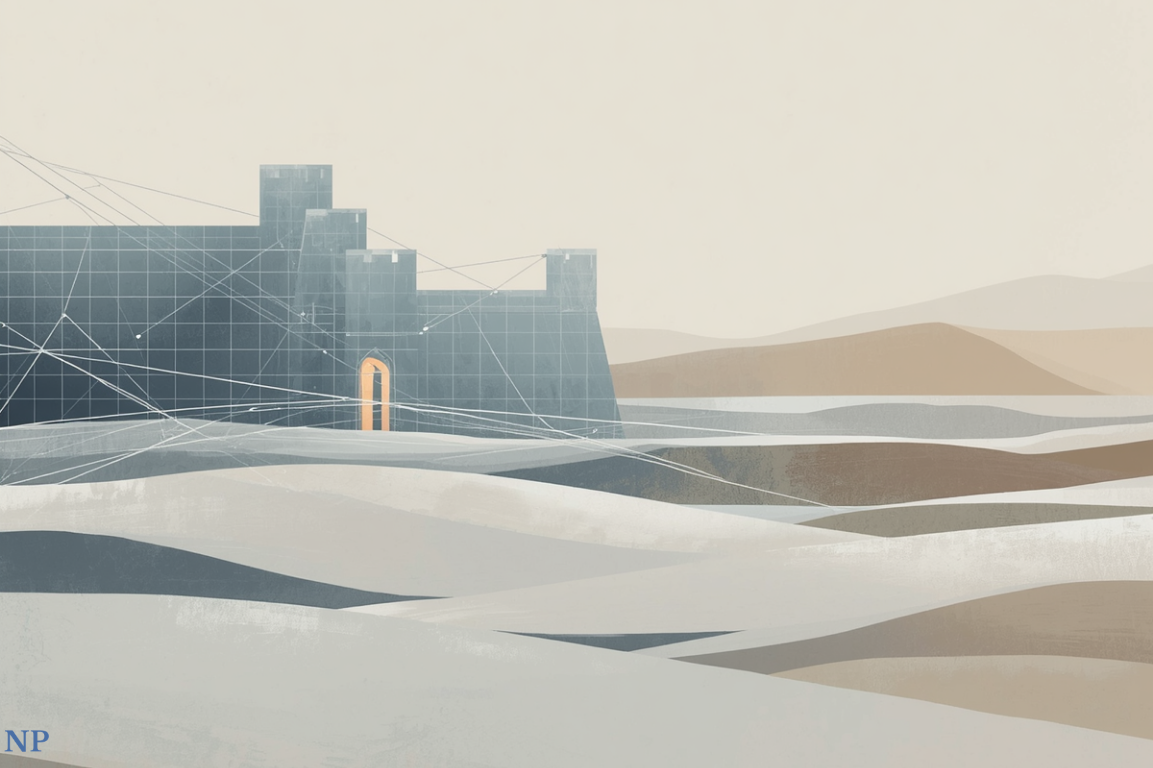
I had spent years building a castle. It took me one morning to see it.
The bedroom was only the beginning. The whole architecture of my life was an engineered system, refined over years, each part calibrated to deliver the next. My weeks ran on a calendar synchronized across work, school, and household: back-to-back meetings sandwiched between morning drop-off and afternoon pick-up, grocery shopping every Saturday from 3 to 4 p.m. at the same Whole Foods next to my older son’s art class studio. My meals were prepped on Sundays — a rotation of yogurt bowls, lentil stews and salads, a perfect composition of balanced macro and micronutrients, decided once so it would not have to be decided again. My workouts followed a five-day split that rotated muscle groups for optimal load and recovery, forty-five to fifty minutes each, short enough to fit into a lunch break at work or after-dinner “free time” at home. My sleep ran like a ritual, identical on weekdays and weekends, identical at home and on vacation. I had built the system to deliver one outcome: the ability to perform — at work, at home, as a mother, as a leader — without ever having to renegotiate or even think about the basics.
It worked. It worked so well that I had stopped noticing it. Every metric I tracked confirmed the system was running. The watch reported consistent training status, sleep and HRV scores. The food journal showed a textbook “healthy” diet, the kind my dietician points to as a model. The workout logs accumulated over a thousand sessions completed and not a single week missed in the past three years. My calendar closed cleanly each week — Outlook to-do tasks cleared, kids' activities and birthday parties checked, laundry folded, fridge restocked. By every measure I had ever used to evaluate whether I was taking care of myself and my family, I was succeeding.
That morning, I understood for the first time that this was the problem.
The metrics I had been using to judge the castle were inside the castle. They had been designed, by me, to measure the castle's performance — to confirm that the routines were running, that the schedule was holding, that I was the person I had been trying to be. They could not, by their construction, tell me what the castle was costing. A sleep score does not know that a body has been fighting to regulate itself overnight. A food journal does not know that the macros, perfect on paper, are colliding with a stress load the journal was never built to detect. A workout log does not know that the muscle is recovering in a body that is, at the same time, quietly running on emergency reserves. The watch told me I had slept eight hours. The graph told me the eight hours had been a war.
For years, my body had been broadcasting — through fatigue I had reframed as productivity, through flatness in certain afternoons that I turned to decaf coffee as my default protocol, through occasional 5 a.m. wake-ups that I repurposed for bonus workouts and convinced myself this is how driven people start their day. The signals had been there. They had been continuous. They had been ignored, not because I was careless, but because the castle's information system had no infrastructure for reading them. They arrived in a language the castle had not been built to translate.
What the CGM did, and what the Garmin's overnight stress data did when read alongside it, was render those signals in a form the castle could no longer filter. Not new information. Translated information. The body had been saying the same thing for years. The graph said it in a language I had spent a career learning to take seriously — the language of data, of evidence, of facts I could not narrate around.
And the moment I could read the language, I could no longer pretend the message had not been arriving the whole time.
This is the harder truth I sat with that Saturday. I had not been failing to take care of myself. I had been taking care of myself with discipline, with intelligence, with years of refinement. The castle was good. The castle had been working. And the castle was, slowly and invisibly, undermining the very thing it had been built to protect. The routines that gave me strength were the same routines that were teaching my body to call emergency baseline. The structure that made me capable was the structure that was costing me capability, in increments small enough that no metric I owned could see them.
I had not built a refuge. I had built a closed system. And inside a closed system, the most dangerous information is the information the system was not designed to read.
The Other Castles
The longer I sat with the charts, the harder it became to keep the question contained to the body.
If the body had been broadcasting for years in a language my system could not read — and if the CGM and the Garmin had done nothing more than render those signals into a form I could finally receive — then what was being broadcast elsewhere in my life, in languages I had also not learned to translate?
I started asking myself questions I had not asked in a long time.
My team's deliverables were strong. The KPIs were met and the projects were on track. But the team itself — the people, not the outputs — may have been broadcasting something the quarterly check-in was not built to detect. The energy in certain meetings. Who had stopped pushing back. The quiet conversations about opportunities elsewhere. The performance reviews saw none of it, because the metrics had been designed to measure what the team produced, not what the team was carrying. What was the translator for that?
My marriage was functional. The household ran. The calendar synchronized. But there was a language in which a marriage speaks — the conversations focused only on logistics, the evenings centered around family chores, the diminishing celebrations at birthdays and anniversaries over time in the name of efficiencies — and the calendar had no protocol for any of it. What was the translator for that?
And the boys. School reports clean, activities scheduled, milestones met. But there is a language in which a child speaks that has nothing to do with milestones — the 6:30 a.m. yawn when a small voice said “Mom, I’m tired,” the request for pasta at lunch so they could finish in twenty minutes at school, the excitement over “staying in the hotel” because they are allowed to break the routine on vacation. The pediatrician's chart was not built to receive any of it. What was the translator for that?
The body had been lucky. Biotech had built a sensor that could render its language in graphs I had been trained to take seriously. The team did not have one. The marriage did not have one. The boys did not have one. And no one was going to build them.
I sat with that for a long time. The hardest recognition was not that the other castles were running unmeasured. It was that the translator for each of them existed only as a thing I would have to be, not a thing I could install. There was no urgent-low alarm coming for any of them. There was only the question of whether I was paying the kind of attention that could function as one.
What the Castle Was For
I have been sitting with the question for weeks now. I do not have a clean answer. I have a direction.
The translator for the body was a sensor. The translators for the rest are not. The team, the marriage, the boys — each of them is broadcasting in a language no instrument will ever render in graphs I can take seriously. The only translator available is attention. Not attention as a metric to optimize. Not attention as a slot in the calendar. Attention without an agenda — the kind that has no deliverable attached to it, no outcome it is trying to engineer, no version of myself it is trying to confirm. The kind of attention the castle was designed, by its own structural logic, to prevent.
This is harder than I expected when I sat with the charts that Saturday morning. It is easier to wear a sensor than to be one. It is easier to optimize the routine than to leave a room in it unbuilt on purpose — to keep an hour open, a conversation not engineered, an evening unaccounted for, a Saturday morning in which a son can say mom, I'm tired and the response is not the schedule but staying. The castle did not have rooms like that. The rooms like that are what I am learning to leave.
I am not tearing it down. The castle was good. It was built with intelligence and care, and it delivered, for years, the version of me I had decided I needed to be. I do not regret the building. I would do almost all of it again.
But I will leave the next rooms unbuilt. Not because I have failed at building. Because the people I built it for — the team, the marriage, the boys, and the body that has been speaking to me the whole time — were never going to be reached by another wall. They were only ever going to be reached by a door, left open, by someone willing to sit on the other side of it without checking the time.
I built the castle with these hands. I will leave the next rooms unbuilt with the same ones.