The Wrestle Endures: Past Lessons for Learning in the Age of AI
From the printing press to industrialization to the internet, every leap reshaped how we learn. Today, AI is the next tsunami — not just generating answers but demanding judgment. What history teaches us about protecting the fundamentals of learning in the age of machines.
Earlier this summer, I was browsing camp listings for K–5 students. Under STEM, the usual suspects appeared: Lego builders, robotics, coding basics. Then one title stopped me cold: “Future Minds AI: Introduction to Intelligence.” For ages 5–8. The flyer promised campers would “explore chatbots, image recognition, and AI-powered games through hands-on projects.”
“That sounds deep — I could probably learn a thing or two myself,” I thought, only to see both sessions already sold out. AI isn’t coming; it’s here, and parents are lining up early. A pang hit me — had I already left my son behind?
But then another thought crept in: what does it mean to send a rising first grader to “artificial intelligence” camp before he’s mastered double-digit addition? My summers were popsicle sticks and sprinklers, plus the pride of finishing my summer workbook early. Now the stakes feel higher. Are we preparing kids for the world they’ll inherit — or outsourcing childhood to the algorithm too soon?
What’s Happening Now — From Backstage to Frontier
Elementary — The Backstage Crew
That summer camp might not even be my son’s first brush with AI. In early grades, AI is the stage crew: invisible, but everywhere. Millions of kids already use adaptive platforms like DreamBox or IXL. My son may not know the word “algorithm,” but he’s surely felt it — the friendly IXL app that eases up when he stumbles, then tosses a curveball when he’s bored.
Teachers lean on AI too. In Newark, a 3rd-grade teacher showed Bill Gates how Khanmigo, Khan Academy’s GPT-4 tutor, suggested a bland “fruit stand” word problem. She rewrote it with Pokémon cards and Roblox instead — two things her students actually cared about. The AI provided the scaffolding; she added the spark. [1]
Middle School — First Contact
By middle school, the curtain lifts. Students finally meet the machine — sometimes with suspicion, sometimes with delight. English and social-studies teachers are among the most eager experimenters, leaning on AI’s fluency with language. [2] In one lesson, students prompted a chatbot with a historical question, then tore apart its answer: too simplistic, too biased, missing the nuance. The exercise sharpened their thinking — not just consuming AI outputs but critiquing, correcting, and improving them. [3]
And AI itself is starting to become curriculum. Free resources like Code.org’s AI units introduce projects such as training simple models with Teachable Machine, while MIT’s Day of AI sparks debates about fairness and bias. These are exploratory lessons — not yet full courses, but signposts that AI is both tool and subject, something students will need to speak fluently.
High School — The Frontier
By high school, AI is no longer backstage; it’s center stage. A national Pew survey found that nearly one in four upperclassmen who’d heard of ChatGPT had already used it for schoolwork — brainstorming ideas, checking grammar, nudging through tough assignments. [4]
Schools are scrambling to catch up. Khanmigo expanded from a pilot of 40,000 students to more than 700,000 across U.S. districts in 2024–25. Teenagers now work through physics or algebra step by step, with hints that feel less like a cheat sheet and more like a patient coach. [5]
And AI is entering the course catalog. States like Texas and South Carolina are drafting formal AI electives, while national initiatives like TeachAI are helping schools design full curricula and district policies. [6] A student might practice calculus with Khanmigo in the morning, then debate in the afternoon whether AI-generated art counts as “original.”
For teens, AI is both lab partner and test: tool or crutch, partner or cheat, frontier or foundation.
Global Extensions — A Race to Go Early
The U.S. isn’t alone in wrestling with AI in the classroom. Governments worldwide are pushing schools to move early — each with its own spin.
In the U.K., the Department for Education urges cautious use: AI can draft lesson plans or tailor assignments, but students shouldn’t rely on it unsupervised. [7] In China, pilot programs already weave AI into middle-school math and computer science, framed as national competitiveness. [8] India has gone further: its CBSE curriculum now makes AI a formal subject in grades 9–12, on par with algebra and physics. [9] And in Singapore, the national AI roadmap calls for AI literacy in primary school, pitching it as a survival skill for the future workforce. [10]
The message across borders is strikingly consistent: AI is no longer an extracurricular curiosity. Whether in London or Beijing, New Delhi or Singapore, classrooms are being asked to decide what role the algorithm should play — backstage helper, classroom partner, or subject in its own right.
History’s Echoes — What Every Leap Teaches Us
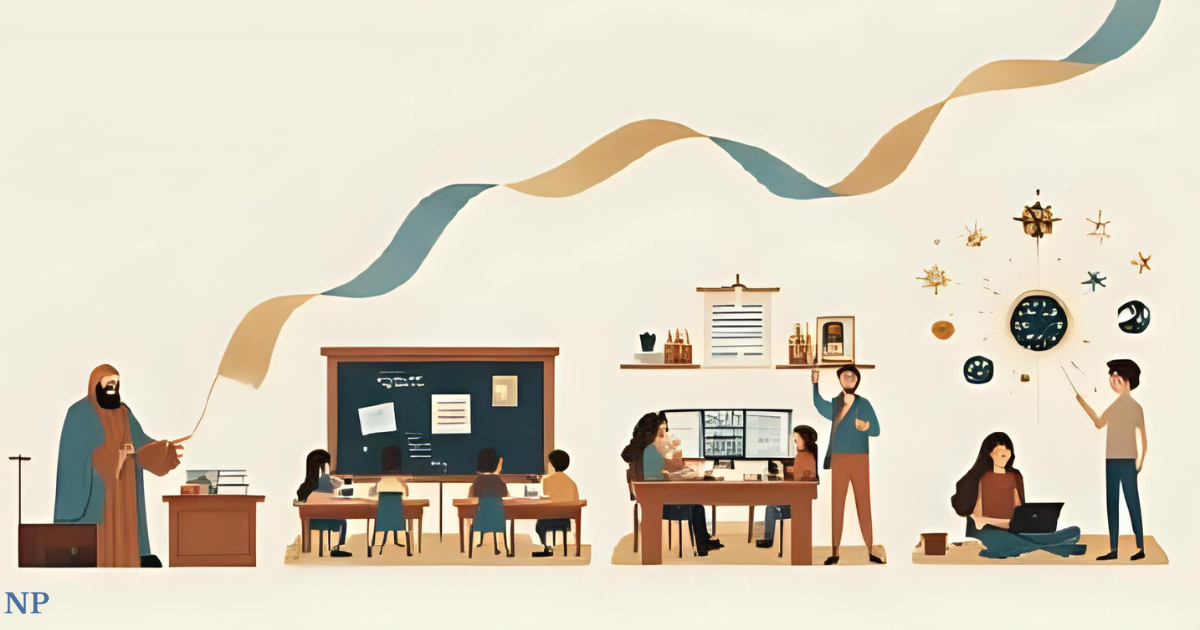
We’re not the first generation to ask this uneasy question: what happens when a new machine enters the classroom? The answers have always been messy at first — resistance, fear, compromise. Yet every wave left the same imprint: tools changed, but the fundamentals of learning endured.
1450s — The Printing Press: From Memory to Literacy
Before Gutenberg, education was an oral, memory-based craft. Students recited line by line, copied texts painstakingly, and stored knowledge in their heads. Education was elite, guarded by monasteries and universities.
When the press made books reproducible and affordable, critics panicked. Church leaders feared heresy would outrun truth. Teachers worried memory would atrophy: why recall if the page could do it for you? Erasmus fretted about “book floods” overwhelming undisciplined minds.
The skeptics were partly right — prodigious memory did fade. But in its place, literacy, interpretation, and critique rose. For the first time, a child could hold the same book as her teacher — not copying word for word, but annotating, comparing, arguing with the text. Cognitively, learning shifted from recall to comprehension; psychologically, students gained agency but also the overwhelm Erasmus had warned of.
The ripple became a current. Literacy surged across Europe, universities multiplied, and ideas once locked in monasteries leapt into public hands. Luther’s 95 Theses ricocheted across Germany, Newton’s Principia reshaped science, Paine’s Common Sense stirred revolution. The very notion of a public informed by reading was born in the current the press unleashed. [11–15]
1800s — Industrialization: From Elite Schooling to Mass Education
Before factories, schooling was patchy. A village priest might teach a handful of boys; wealthier families hired tutors. Most children learned arithmetic at the market stall or letters from a parent. Education was elite, local, and uneven.
Industrialization changed the equation. Steam presses and cheap paper made textbooks affordable; railroads carried them everywhere. Factories demanded punctual, literate workers; nation-states wanted citizens who could read ballots, manuals, and patriotic tracts. Schooling became not philanthropy but infrastructure. [16]
The adjustment was bumpy. Rural parents resisted losing child labor; critics sneered at “factory schools” producing compliance. Yet necessity won. Reformers like Horace Mann in Massachusetts pressed for compulsory, tax-funded schools, calling education “the balance wheel of the social machinery.” [16] In France, Jules Ferry’s 1881–1882 laws declared free, compulsory schooling both a right of the child and a duty of the state. [17]
Cognitively, classrooms drilled the three Rs — reading, writing, arithmetic — with new intensity, turning literacy and numeracy into scalable basics. Psychologically, schools disciplined the mind — bells for punctuality, rows for order, repetition for persistence — while curiosity survived in scribbled margins and late-night debates.
The current swelled into a tide. At the population level, reformers pushed through universal schooling. By 1900, literacy in Western Europe topped 80%; in the U.S., adult literacy surpassed 90%. Society reaped the payoff: trained workers for factories, informed voters for democracies, and scientific progress from labs staffed by a literate public. [18–19]
1990s–2000s — The Internet: From Gatekeepers to Googling
Before the modem’s hum, research meant card catalogs and photocopies. Teachers and librarians were the gatekeepers, and knowledge lived in libraries or printed textbooks.
When the web arrived in schools, it felt miraculous and menacing. In 1994, only 35% of U.S. public schools were online; by 2000, it was 98%. [20] Suddenly, the world’s knowledge was a click away. Critics panicked: Would Google kill memory? Would Wikipedia rot research skills?
The fears weren’t baseless. Cognitively, students swapped retrieval for evaluation — learning to sift thousands of hits. Psychologically, they gained empowerment and distraction in equal measure. A rural teen could access MIT lectures, but also lose hours to AIM or MySpace. Attention splintered; curiosity mingled with distraction.
At the population level, the web meant ubiquity. By the mid-2000s, over 90% of U.S. teens were online daily. Research papers required web citations, computer science became mainstream curriculum, and MOOCs made Stanford lectures accessible to anyone with Wi-Fi. [21–22]
The tide became a global wave. Scientific journals went digital, Wikipedia became the launchpad of learning, and civic life moved into forums and social media — messy, democratized, sometimes toxic, but undeniably participatory. The internet didn’t just change how students learned; it redefined what it meant to be a learner.
2020s — Artificial Intelligence: From Answers to Judgment
Now the wave crests into a tsunami. AI doesn’t just deliver information — it generates it. The danger is obvious: over-reliance risks turning learners into spectators (or worse, confident consumers of wrong answers). Yet the potential is equally profound: AI can scaffold motivation, adapt for special needs, and free teachers to focus on the human heart of learning.
Cognitively, the wrestle shifts again. Students must move beyond recall — beyond even research — into discernment and judgment. Psychologically, AI can boost confidence when used well, but can also erode self-reliance and blur authentic social interaction. At scale, AI promises personalization for millions — but risks widening divides between those guided thoughtfully and those left to the algorithm unguided.
The question is no longer whether AI will change classrooms — it already has. The question is whether we will let the tsunami sweep away the fundamentals, or teach the next generation to ride it.
My Verdict — History’s Chorus
Every leap sparked panic. The press threatened memory; industrialization drilled curiosity into conformity; the internet fractured attention with endless tabs. Each time, something old eroded. Each time, something enduring rose: literacy, mass numeracy, information literacy. And each time, one thing survived — the wrestle.
AI is the next verse — but its scale feels different, less like a tide, more like a tsunami. If the machine can solve the math, draft the essay, personalize the lesson — what’s left for the student? The wrestle, yes, but also something larger: deciding when to lean on the machine, when to push against it, and when to step away. The skill is no longer just judgment; it is wisdom — the ability to balance convenience with curiosity, efficiency with effort, answers with understanding.
Maybe the best gift I can give my son isn’t shielding him from the algorithm, nor racing him ahead of it — but teaching him to stay in the wrestle: to think, to question, to create, before asking the machine to do it.
Endnotes
[1] Gates, B. (2023). The Age of AI Has Begun. GatesNotes.
[2] RAND Corporation / CRPE (2023). American Instructional Resources Survey: Early AI Use by Teachers.
[3] ISTE (2023). Classroom Use Cases of Generative AI.
[4] Pew Research Center (2023). Teens, ChatGPT, and AI: Awareness and Use.
[5] Khan Academy (2024). Khanmigo Adoption Data (2024–25).
[6] TeachAI (2023). K–12 AI Education Framework.
[7] UK Department for Education (2023). Generative AI in Education: Guidance for Schools.
[8] Ministry of Education, China (2023). AI Education Pilot Programs.
[9] CBSE, India (2023). AI Curriculum Framework for Grades 9–12.
[10] Smart Nation Singapore (2022). National AI Literacy Roadmap.
[11] Houston, R. (1988). Literacy in Early Modern Europe.
[12] Buringh, E., & van Zanden, J. L. (2009). Charting the “Rise of the West”: Manuscripts and Printed Books in Europe, 1300–1800.
[13] Pettegree, A. (2015). Brand Luther: 1517, Printing, and the Making of the Reformation.
[14] Eisenstein, E. (1979). The Printing Press as an Agent of Change.
[15] Foner, E. (1948). Thomas Paine’s “Common Sense”.
[16] Kaestle, C. (1983). Pillars of the Republic: Common Schools and American Society, 1780–1860.
[17] Prost, A. (2004). Education, Society, and Politics in France, 1945–1995. Oxford: Berghahn Books.
[18] Vincent, D. (2000). The Rise of Mass Literacy: Reading and Writing in Modern Europe.
[19] U.S. Census Bureau (1900). Historical Statistics of the United States: Literacy Tables.
[20] U.S. Dept. of Education (2000). Internet Access in U.S. Public Schools and Classrooms: 1994–2000.
[21] National Center for Education Statistics (2003). Public School Use of Technology: 2003.
[22] Pew Research Center (2005). Teens and Technology Adoption.