
The True Currency of Saving: Money, Time, Health, and Headspace
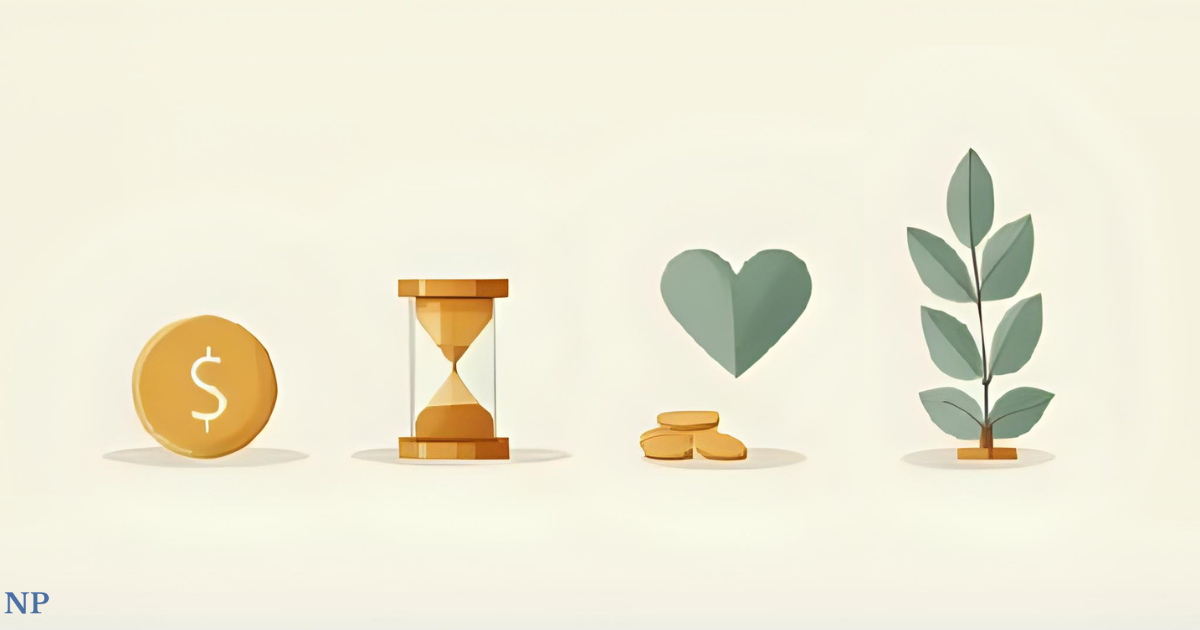
Saving has always meant preservation. Once it was grain in a jar or coins under a mattress; today it might be minutes bought back with grocery delivery, health safeguarded with a jog, or mental space freed by outsourcing chores.
New Year’s Eve, after the kids finally went quiet, my husband and I slumped across from each other, exhausted. Our resolution was simple: keep the house running without losing our sanity. We made a list: outsource yard work so he could sit at the dinner table instead of behind a mower; bring in a biweekly cleaning service to calm the clutter; eat out on weekends so we could savor food instead of scrubbing pots. Then I did what any analyst would: opened a spreadsheet and ran scenarios—base case, modest upgrade, full upgrade. The all-in cost? Under $20K a year. We jumped.
It turned out to be one of our best financial decisions: fewer arguments on hectic nights, new experiences with the kids, more energy for the projects that matter. And it left me wondering: was I really spending—or was I saving? Why did it take us so many lost years to understand what saving truly means?
The Gold Standard Currency — Saving as Money
For most of human history, saving meant one thing: money—or whatever passed for it. Nearly every culture found a way to sanctify thrift. Franklin in early America preached that “a penny saved is a penny earned.” In China, Confucian scholars called thrift the foundation of virtue. Across West Africa, Yoruba elders warned, “Do not eat tomorrow’s yam today.” The Qur’an cautioned believers that wastefulness was a moral failing. However it was phrased, the message was the same: to save was not just practical, it was righteous.
And in a pre-industrial world, that righteousness made sense. Productivity was low, wages meager, harvests uncertain. A few coins under the mattress, grain sealed in a clay pot, a pig fattened for winter—these weren’t luxuries; they were lifelines. In wartime, saving became civic duty: Americans were urged to “Save for Victory,” Britons planted Victory Gardens, and rationing kept households afloat.
Even today, saving takes many forms but serves the same primal role: a buffer against uncertainty. Nearly 1.4 billion adults worldwide remain unbanked, relying on livestock, grain, or jewelry as safety nets. In India, more than 80% of household wealth is still held in physical assets rather than financial accounts. In sub-Saharan Africa, families often save through rotating credit groups or herds they can sell when crisis strikes. Different vessels, same instinct: survive the next storm.
Over time, those jars of grain and bundles of gold evolved into more sophisticated instruments. Bank accounts, pensions, and insurance policies still provide security; equities and real estate add growth. Today, nearly half of global household wealth is held in real assets like homes and land, while trillions more sit in retirement accounts and equities.¹ Whether it’s farmland in India, cooperative savings groups in Kenya, or 401(k)s in the U.S., the packaging changes but the impulse is the same: preserve optionality for a future self who cannot yet earn—or predict what’s coming.
.
The Hidden Currencies of Saving
I grew up in a Chinese household where thrift was second nature. Saving money quietly guided every choice, from grocery shopping to planting my own garden. And it worked—until it didn’t. The bank balance rose, but so did burnout. We ran on the clock all day, collapsed at night, and carried stress that strained health and relationships alike. That was my wake-up call: saving isn’t only about dollars. What else is worth protecting?
Time
If money was yesterday’s scarcity, time feels like today’s. Across cultures, surveys echo the same refrain: people feel starved for hours. In the U.S., more than 60% of adults say they “almost never” have enough time to do what they want, a figure that has barely budged in decades.² In Europe, work–life balance consistently ranks among the top three stressors in Eurobarometer surveys.³ In much of the developing world, the picture is sharper still: the UN estimates that women spend nearly three times as many hours as men on unpaid labor—fetching water, preparing food, caring for children—a burden researchers call time poverty.⁴
Why does time feel tighter than ever? Technology makes work omnipresent: Slack pings and late-night emails pull jobs into evenings. Dual-earner households, now the majority in the U.S., juggle careers alongside school runs and elder care. The “sandwich generation” stretches days in two directions at once.
So people respond—often by spending to save time. Behavioral economists call this buying time, and the evidence suggests it works: people who spend on time-saving services (from hiring cleaners to paying for grocery delivery) report greater life satisfaction than those who don’t.⁵ We already pay to skip lines—TSA PreCheck, ride-hailing, even Disney’s “skip the line” passes—trading dollars for minutes. The cost may sting, but the return is relief: fewer arguments, more dinners together, a little less of the chronic hum of hurry.
In that sense, saving time is the modern luxury. Unlike money, it cannot be stockpiled or invested. Each day resets the account to zero. The only choice is whether we spend to preserve it—outsourcing, automating, decluttering—or let it slip away untended.
Health
If money preserves freedom and time preserves sanity, health preserves the very possibility of tomorrow. But here, too, the link between spending and saving isn’t straightforward.
At the individual level, the relationship is lopsided. Preventive spending has outsize returns: regular exercise cuts premature mortality risk by up to 30%, and diets rich in fruits and vegetables reduce cardiovascular risk by a similar margin.⁶ A $50 pair of running shoes or a few extra dollars for produce can yield dividends no pill can match. But after the basics, diminishing returns kick in quickly. Americans now spend nearly $50 billion a year on vitamins and supplements, with little evidence most improve long-term outcomes.⁷ Boutique powders and wellness elixirs often deliver more peace of mind than measurable vitality.
At the national level, the paradox is sharper. The U.S. spends nearly 17% of GDP on healthcare, the highest in the world, yet ranks 40th globally in life expectancy.⁸ Meanwhile, Japan spends about half as much per capita but has one of the world’s longest lifespans. The difference isn’t only money—it’s systems. Countries that channel more into prevention and universal access stretch their health dollars further; those that lean on treatment and technology, like the U.S., end up with dazzling ICUs but disappointing population health.
Step back, and researchers see a pattern. First, a minimum threshold: below a certain level of health spending, outcomes collapse—maternal and infant mortality rise, infectious diseases persist.⁹ Second, diminishing returns: once nations reach middle- to high-income levels, the curve flattens. The Preston curve shows life expectancy climbing steeply at first but tapering as spending grows.¹⁰ Third, insufficiency: when systems are misaligned—prioritizing treatment over prevention, burdened by administrative waste, or leaving large groups uninsured—even sky-high spending cannot buy longevity.¹¹
What does this mean for us? Individually, health dollars buy the most when they preserve vitality through prevention—exercise, nutritious food, check-ups, safe environments. Societally, the same principle holds: money matters, but design matters more. Saving health isn’t about pouring in more; it’s about preserving the right things—resilience, equity, access.
Mental Space
If money saves freedom, and time saves sanity, then mental space saves clarity. But spending here is a double-edged sword: it can clutter the mind just as easily as it can clear it.
We’ve already seen how spending hijacks attention—the dopamine hit of bargains, the trap of closets filled with yoga pants. The point isn’t to repeat that story, but to recognize that every choice, no matter how small, leaves a residue on the mind.
The real cost is decision fatigue. One study estimated the average American makes more than 200 food-related decisions per day, most unconsciously.¹² Add the digital layer: the typical smartphone user checks their device 144 times daily and fields 46 push notifications.¹³ Each ding or “should I/shouldn’t I” moment drains bandwidth, leaving us less capable of focusing where it matters.
Here’s where spending can actually save us. People who spend to reduce small, draining choices—outsourcing chores, subscribing to meal kits, automating bills—report higher life satisfaction and lower stress.¹⁴ I learned this the hard way. For years, my husband and I circled the same weekend-chore debate until both of us were simmering. Finally, we paid for house cleaning and the saving was immense. The clutter left the floor—and, more importantly, it left my head.
And then comes the multiplier. Mental space fuels all the others. Freeing bandwidth creates time—fewer minutes lost dithering, more hours for what matters. It preserves health—decision fatigue impairs self-control and elevates stress, eroding both body and mind.¹⁵ And it restores identity—when the noise quiets, attention realigns toward values instead of distractions.
The paradox is that money can both clutter and clear the mind. The question isn’t whether dollars buy peace of mind, but how we deploy them. Are we spending to flood our heads with more noise—or spending to guard clarity itself, the scarce bandwidth on which time, health, and meaning depend?
My Verdict
For years I thought saving meant denial—clipping coupons, skipping lattes, watching balances inch upward. Slowly I’ve realized saving has always been about something bigger: preservation. The question has never been how much we save, but what we are saving for.
I learned this when my husband and I stopped chasing pennies and started spending to save our sanity—outsourcing chores, trimming yard work, saying yes to takeout. On paper, it looked like spending. In reality, it was saving: saving time, saving energy, saving the mental space that made room for laughter again.
The same logic applies everywhere. Saving money preserves freedom. Saving time preserves possibility. Saving health preserves vitality. And saving attention—something I’ve come to prize most—preserves clarity in a world bent on splintering it. For me, that sometimes looks like paying for groceries already chopped or saying no to yet another extracurricular, not because I can’t afford it, but because I can’t afford the drain it places on everything else.
So maybe the wiser way to think about saving isn’t subtraction at all. It’s alignment. Spend less on what matters least so you can preserve what matters most. For my grandparents, saving meant security—the confidence that food and shelter would be there tomorrow, even in uncertain times. For me, saving looks different: not dollars under the mattress but hours at the dinner table, energy left to write, and the rare luxury of quiet in my own head. The currency has changed, but the instinct hasn’t—preserve what’s most fragile, so life feels livable again.
Endnotes
- Credit Suisse (2022). Global Wealth Report.
- Gallup (2021). The Wellbeing Index: Time Use Findings.
- European Commission (2020). Eurobarometer: Quality of Life in Europe.
- UN Women (2020). Progress of the World’s Women: Time Use Data.
- Whillans, A. et al. (2017). “Buying time promotes happiness.” PNAS, 114(32), 8523–8528.
- World Health Organization (2020). Global Health Risks.
- National Institutes of Health (2022). Dietary Supplement Use in the United States.
- OECD (2023). Health at a Glance.
- World Health Organization (2010). World Health Report.
- Preston, S. (1975). “The Changing Relation between Mortality and Level of Economic Development.” Population Studies, 29(2).
- Anderson, G. & Frogner, B. (2008). “Health Spending in OECD Countries.” Health Affairs.
- Wansink, B. & Sobal, J. (2007). “Mindless Eating and Food Decision Making.” Environment & Behavior.
- Asurion (2019). Smartphone Habits Study.
- Baumeister, R. et al. (1998). “Ego Depletion: Is the Active Self a Limited Resource?” Journal of Personality and Social Psychology.