The Disappearing Lunch Break: From Desk Salads to Survival Naps - What our midday pause reveals about pressure, culture, and choice
From factory whistles to desk salads, from Parisian cafés to Tokyo bentos, the lunch break has always been more than a meal. Today it is shrinking, reshaped by law, technology, culture, and economics — a mirror of what societies choose to protect, and what they quietly surrender.
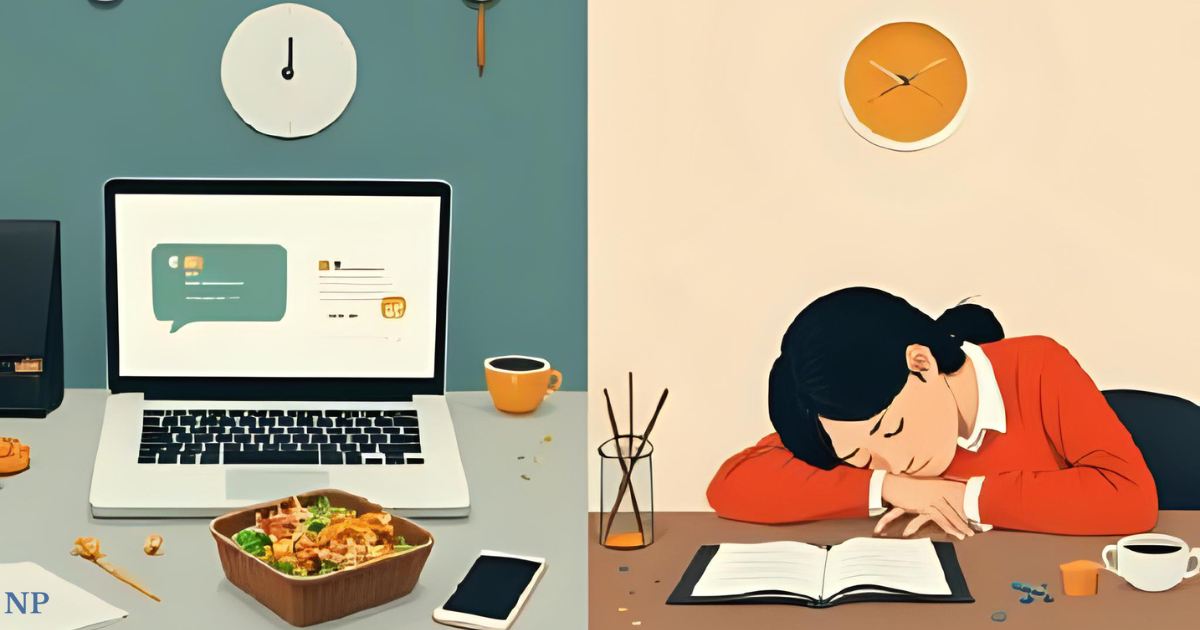
On my recent trip to China, my family gathered for lunch at a bustling neighborhood restaurant. To my surprise, my cousin — a lead interior designer — slipped in to join us. “I’m so glad you made it,” I said. She laughed: “No worries, I just skipped my after-lunch nap to stretch the break.” I smiled, but thought of my own routine back in the U.S. — a grab & go salad eaten at my desk, camera off on a Teams call. For a moment I envied her.
But when we met again that weekend, she admitted that her usual 7 p.m. departure had stretched to 9 p.m. to make up for the longer lunch. She called it her “996 life with a nap” — 9 a.m. to 9 p.m., six days a week, with rest squeezed in to survive the hours. My envy evaporated. What I realized is that we are both living the same story of the disappearing lunch break. Mine has shrunk into a desk salad, hers has morphed into a survival nap. Different forms, same erosion. What happened to lunch?
From Whistles to Desk Salads — The U.S. Story
It wasn’t always this way. In the early 20th century, lunch was a true break. Factory whistles blew at noon, and workers poured into diners or sat outside with packed tins. The pause was so important that it became part of labor battles: the Fair Labor Standards Act of 1938 set hours and wages, and unions often bargained explicitly for meal rights. For blue-collar workers, the lunch break was literal survival — a chance to rest sore muscles and refuel for another shift.
White-collar workers, meanwhile, wrote a very different script. In the 1950s and ’60s, the “business lunch” was its own theater. Deals were sealed in steakhouses, washed down with two — or three — martinis. Lunch wasn’t just about food; it was about access. While blue collars fought for rest, white collars feasted for opportunity.
But by the late 20th century, both versions began to unravel. For blue collars, the collapse came with union decline. In the 1950s, one in three American workers carried a union card; by the 2000s, that share had fallen to just 10%.¹ And where unions did survive, their priorities shifted — toward wages, pensions, and healthcare, the bigger-ticket fights in a globalizing economy.² Meal breaks were no longer sacred; they became negotiable, sometimes expendable.
For white collars, the unraveling looked different. The “power lunch” had always been an elite ritual, not a mass reality. As office work ballooned — service and knowledge jobs grew from under 30% of the U.S. workforce in 1950 to over 70% by 2000³ — the martini lunches of Mad Men became less glamorous and more ridiculous. By the 1980s, “power lunch” was shorthand for excess. By the 1990s, the very idea of a long lunch clashed with the cult of efficiency. Email, cell phones, and the early internet made it easier — and expected — to work straight through.⁴
What was once ritual — whether a union-protected pause or a martini-fueled performance — shrank into inconvenience. And in the decades since, five forces have conspired to push it further to the margins.
The Five Forces Behind the Collapse
1. Law and Policy. Unlike Europe, the U.S. never guaranteed a midday pause. The Fair Labor Standards Act of 1938 set hours and wages but left meals optional. Courts later reinforced the loophole: if you can “work while eating” — answering emails over a sandwich — it doesn’t count as time off.⁵ With no federal shield, breaks became bargaining chips. Some states now mandate meal periods, but enforcement is patchy, and in practice lunch is often the first thing to vanish when deadlines loom.
2. Technology. The desk became the cafeteria tray. Email in the 1990s untethered work from place; smartphones in the 2000s untethered it from time. By the 2010s, Slack and Teams made it constant. A Deloitte survey found nearly half of U.S. professionals now work through lunch at least three times a week.⁶ The very tools that promised flexibility collapsed the boundary between “on” and “off,” turning lunch into just another calendar slot.
3. Culture of Efficiency. By the 1990s, more than half of U.S. office workers were already eating at their desks,⁴ but in finance and tech the shift went further. Skipping lunch became a signal of grit: Wall Street analysts proved stamina by working through meals, while Silicon Valley engineers blurred cafeteria food into stand-up meetings.⁸ Free food wasn’t about generosity — it was about keeping workers tethered. The cultural script had flipped: pausing turned indulgent; powering through became virtue.
4. Economics of Productivity. Lean staffing made breaks fragile. Nearly 80% of fast-food workers reported working through meals or rest periods.⁹ Knowledge workers felt a different squeeze: in fields like finance or law, “face time” acted as currency, and the associate who skipped lunch looked hungrier — literally and figuratively. Since the 1980s, U.S. productivity has surged by more than 70% while wages crept up less than 12%.¹⁰ In that gap, efficiency hardened into ethos. Lunch became an unproductive luxury, sacrificed in the name of output.
5. The Stress Test. COVID didn’t create the decline, but it exposed it. Home and office collapsed into the same space, and the break room disappeared altogether. Surveys found that 76% of in-office workers now eat lunch at their desks at least half the time, and 55% of employees skip lunch on busy days to look more productive.¹¹ The pandemic was less a new force than an amplifier, revealing how fragile the lunch break already was — and how quickly it could vanish when pressure spiked.
Lunch in Translation — A Global Lens
France — Lunch by Law. In Paris, lunch is not negotiable — it’s legislated. French labor codes guarantee a midday pause, and many firms enforce a droit à la déconnexion — the right to disconnect from email during breaks. For decades, this meant two-hour meals with colleagues, wine glasses clinking over plat du jour. But even here, adaptation creeps in: shorter, faster lunches are becoming common in global firms, where French workers juggle the pull of tradition against the tempo of multinationals.
Japan — Lunch as Ritual Discipline. In Tokyo, the pause is quieter but no less telling: boxed bento lined up on desks, colleagues unwrapping and eating together as a gesture of solidarity. The ritual is short, almost austere — not indulgence, but discipline. It reflects a deeper ethic of harmony: even in long-hour cultures, everyone eats at the same time, together. Yet the brevity signals adaptation — the pause remains, but compressed, a pocket of ritual folded into relentless workdays.
India — Lunch as Continuity. In Mumbai or Chennai, office towers are still fed by the dabbawalas — armies of men ferrying home-cooked meals across the city with astonishing precision. Lunch here is more than fuel; it is cultural continuity, a link between home kitchens and office desks. Yet global schedules press in: multinationals normalize working lunches, and younger professionals grab fast food between meetings. The dabba endures, but often next to a laptop — tradition adapting to the tempo of globalization.
Brazil and Argentina — Lunch as Family Table. In São Paulo or Buenos Aires, the lunch break stretches into something closer to a homecoming. Shops shutter, offices empty, and workers head home for a hot meal with family. It is both ritual and resistance, a cultural insistence that the midday table matters. But adaptation is visible here too. Multinationals and urban service economies chip away at the long pause; in some sectors, the family lunch has shifted into a weekend ritual instead. The tradition bends, but the instinct — to return home, to make the meal communal — persists.
Across France, Japan, India, Brazil, and Argentina, lunch breaks survive in different forms — legislated pause, ritual discipline, survival strategy, cultural continuity, or family table. Each has bent under the same global pressures that shrank the American lunch: law too weak, tech too loud, culture too fast, economics too lean. The break hasn’t vanished everywhere, but everywhere it has adapted — compressed, repurposed, negotiated.
My Verdict
When my cousin in China skipped her nap to join me for lunch, only to work late into the night, I thought: at least she had a pause. When I eat salad over Teams calls, I think: at least I have my evenings. Different forms, same erosion. Lunch hasn’t disappeared so much as fractured, reshaped by the systems we live inside.
In the U.S., it shrank under the weight of law, technology, culture, and economics — from factory whistles and martini steaks to microwaved leftovers at the desk. In Asia, it survives as ritual discipline or endurance fuel. In Europe and South America, law and tradition still carve out space, even as global pressures chip at the edges.
The through line is this: lunch is never just about food. It’s about what a society values enough to protect — survival, efficiency, community, or continuity. Each culture writes its own answer, and each of us negotiates within it.
For me, rebellion looks small: an occasional lunch date with my husband, or walking away from my desk long enough to taste something hot from a restaurant near the lake. They’re not grand gestures, but they’re a quiet insistence that the pause matters.
When my cousin called her schedule “996 with a nap,” I heard the echo of my own desk lunches across the ocean. Different forms, same compromise. Lunch is a mirror — and what disappears isn’t the meal, but the values that once guarded it. Reclaiming it is not about food; it’s about remembering that life is more than output.
Endnotes
- Bureau of Labor Statistics. Union Membership Historical Data.
- Freeman, R. & Medoff, J. What Do Unions Do? (1984).
- U.S. Census Bureau, Historical Statistics of the United States.
- Cahill, M. (1990). “The Decline of the Business Lunch.” Journal of Social History.
- U.S. Department of Labor. Fair Labor Standards Act Guidance.
- Deloitte (2019). Workplace Flexibility and Lunch Habits Survey.
- Gideon Kunda. Engineering Culture: Control and Commitment in a High-Tech Corporation. (1992).
- O’Malley, K. (2018). “The Decline of the Lunch Break in Tech Culture.” Wired.
- Fast Food Forward Survey, 2012.
- Economic Policy Institute. Productivity–Pay Gap Data (2021).
- EZCater Lunch Report (2022).