
Perfect Attendance, Imperfect Routine. When calendars collide, chaos isn’t personal—it’s structural
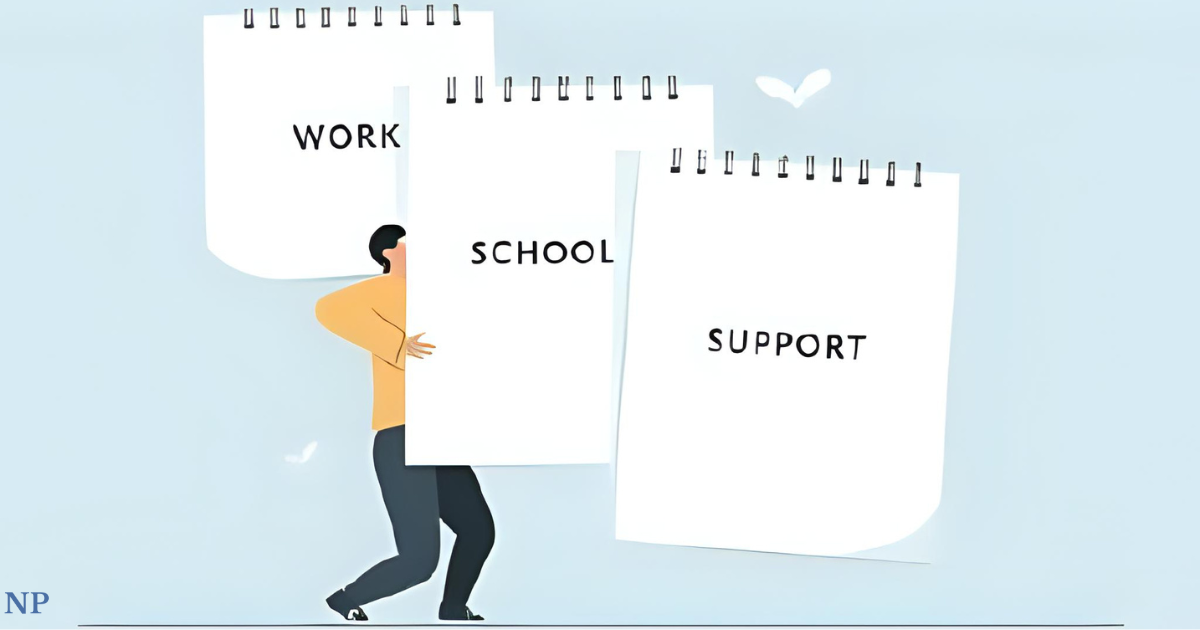
The morning relay in my house runs on alarms, quick breakfasts, and backup routes. If it feels chaotic, it isn’t disorganization—it’s work, school, and support colliding before 8 a.m., shaped by four invisible forces: coordination, control, capabilities, and culture.
The chapel was full of restless kids and proud parents gathered for the school’s end-of-year award ceremony, sunlight spilling through stained glass as the principal announced that my first grader was one of only three students to earn “perfect attendance”—never once late to carpool drop-off. I smiled, but what I really thought was: this is an award for the whole family, earned through mornings of synchronized alarms, quick breakfasts, and exits practiced like a relay.
Our choreography begins at 6:30 a.m., when alarms in every bedroom go off like a choir—loud, overlapping, and impossible to ignore. My husband gets the kids into uniforms and teeth brushed while I head downstairs to start breakfast. The menu is curated with three strict criteria: reasonably nutritious, quick to eat, and unlikely to cause a mess. By 7:05, the kids are at the table eating on their own while we pivot to getting ourselves ready. If all goes to plan, we’re in the car by 7:30, sliding into the drop-off line just before 7:45.
Curveballs are baked in. If I have a 7 a.m. Teams call, I set my alarm 30 minutes earlier to finish my part before the rest of the house stirs. If traffic snarls, we switch to the backup route we know by heart.
It’s less a serene ritual than a high-stakes relay—but it gets us across the finish line. And if mornings feel chaotic, it isn’t because families are sloppy. It’s because three calendars—work, school, and support—collide at once. Underneath those calendars sit four invisible forces scripting our mornings: coordination, control, capabilities, and culture.
Coordination — Calendars That Don’t Line Up
Work pulls parents into early calls to overlap with colleagues abroad; nearly 43% of meetings now happen outside local business hours¹. Schools add their own rigidity: bus tiers and class schedules designed for efficiency, not for children’s sleep cycles. And without grandparents or neighbors nearby, parents end up as the only coordinators—juggling Teams calls, shoes, and backpacks before 8 a.m.
Control — The Hard Rules We Can’t Bend
Institutions set clocks families can’t negotiate. At work, presence still signals ambition: over 60% of remote workers say they feel pressure to be “always on³.” In schools, punctuality is celebrated with “perfect attendance,” though research shows such awards don’t improve learning and can even backfire⁴. Once children reach grade school, the rigidity deepens. Only about 20% of U.S. middle and high schools start after 8:30 a.m.², even though delaying start times gives students about 34 minutes more sleep each night and measurable gains in math and reading⁶ ⁷. In childcare, control looks like scarcity. Nordic countries guarantee subsidized slots with flexible hours; in the U.S., half of parents report being waitlisted for care, often for a year or more⁵.
Capabilities — What the System Makes Possible
Technology doesn’t just enable; it shapes what we do. Remote work surged during COVID, with 70% of full-time employees at home in 2020⁸. The wave receded, but the tools and habits stuck: about 30% of workdays are still remote in 2023⁹. That means mornings, once buffered by a commute, are now open territory for meetings. Schools lean on routing software and automated attendance systems that maximize efficiency but leave little slack. Before-school programs remain patchy, covering only about 30% of schools nationwide¹⁰. Families improvise with carpools, meal kits, and delivery apps—creative fixes, but not systemic solutions.
Culture — The Stories We Tell About Time
If control sets the rules, culture gives them meaning. In the U.S., being the early bird still reads as ambition—a modern echo of the Protestant ethic¹¹. Nordic countries take pride in shorter days and later starts. Mediterranean households stretch mornings and evenings to protect family meals. Schools reflect these values: Japanese mornings emphasize punctuality and uniformity; American ones independence; Southern European ones flexibility. And in support, culture is decisive: Americans valorize self-sufficiency, while many Asian and Latin families assume grandparents or neighbors are part of the morning team.
My Verdict
When the principal handed my son his “perfect attendance” certificate at the end-of-year ceremony, I clapped like every other parent. But I knew the award wasn’t just his. It belonged to the alarms set in stereo, the 7 a.m. Teams calls ducked and rescheduled, the backup routes rehearsed, the quiet pressure to hold it all together without extra hands.
That certificate was less a sign of discipline in one child than proof of how our mornings are shaped by forces bigger than us—coordination, control, capabilities, and culture. Work pulls calendars earlier, school locks them rigid, support systems leave gaps, and culture tells us what it all means.
Families adapt—we invent hacks to survive the relay—but the race itself is drawn elsewhere. Morning routines aren’t private quirks; they’re mirrors of what a society values. Some cultures prize rest, others punctuality, others independence. Ours has chosen speed, productivity, and self-sufficiency.
And that, perhaps, is the real takeaway. The chaos in my kitchen isn’t disorder; it’s design. The only question is whether it’s a design we want to keep running—or one worth rewriting.
Endnotes
- Bernstein, E., Shore, J., & Lazer, D. (2018). How Intermittent Breaks Help You Reenergize at Work. Harvard Business School Working Knowledge.
- Wheaton, A. G., Ferro, G. A., & Croft, J. B. (2015). School Start Times for Middle School and High School Students — United States, 2011–12. MMWR, 64(33), 809–813.
- Microsoft (2021). Work Trend Index: The Next Great Disruption Is Hybrid Work—Are We Ready?
- Robinson, C. D., Lee, M. G., Dearing, E., & Rogers, T. (2018). Reducing Student Absenteeism in the Early Grades by Targeting Parental Beliefs. Nature Human Behaviour, 2(5), 335–342.
- Malik, R. et al. (2023). Child Care Deserts and the Supply of Child Care in 2023. Center for American Progress.
- Dunster, G. P., de la Iglesia, L., Ben-Hamo, M., Nave, C., Fleischer, J. G., Panda, S., & de la Iglesia, H. (2018). Later school start times promote sleep and improve academic performance in high school students. Science Advances, 4(12), eaau6200.
- Edwards, F. (2012). Early to rise? The effect of daily start times on academic performance. Economics of Education Review, 31(6), 970–983.
- Brynjolfsson, E., Horton, J., Ozimek, A., Rock, D., Sharma, G., & TuYe, H. (2020). COVID-19 and Remote Work: An Early Look at U.S. Data. NBER Working Paper No. 27344.
- Barrero, J. M., Bloom, N., & Davis, S. J. (2023). Why Working From Home Will Stick. NBER Working Paper No. 28731.
- Afterschool Alliance (2020). America After 3PM: Demand Grows, Opportunity Shrinks.
- Weber, M. (1905/2002). The Protestant Ethic and the Spirit of Capitalism. Routledge.