Holding the Center in Two Languages: Sandwich Generation 2.0
The sandwich generation isn’t just a phase—it’s a global reality. This essay traces two millennial caregivers—one near, one far—navigating aging parents, young children, and vanishing support systems, all while redefining what it means to hold the center.
At 6:50 a.m., my kitchen in suburban Maryland hums with the usual choreography. The boys are negotiating over who gets the blue cup, the coffee machine sputters like it resents being awake, and I’m packing lunches with one hand while replying to a Teams message with the other—headset hanging around my neck, ready for the meeting that starts in a few minutes.
Somewhere between sealing the snack bags and locating the school red folder, I glance at my phone: WeChat notifications from my parents in China. A photo of my mom holding the goodies I ordered from Amazon to help her recover from surgery. A reminder from myself to track down the other missing package. And then, like clockwork, the small, familiar guilt that arrives before the day even begins.
Eight thousand miles away, in my cousin’s apartment in a bustling Chinese city, the same hour looks entirely different—and somehow exactly the same. Her parents-in-law live just two blocks away, close enough to help but close enough to need things too—a strategic decision made years ago when they gifted my cousin and her husband part of their downpayment. As she heads out the door, her mother-in-law hands her a neatly packed lunch bag and reminds her to book a restaurant for her father-in-law’s birthday and the pediatrician appointment for her daughter. Her boss pings her at 7:12 a.m. about an all-hands working session at 5 p.m., the third overtime night this week. Three generations, one kitchen—and no margin for rest.
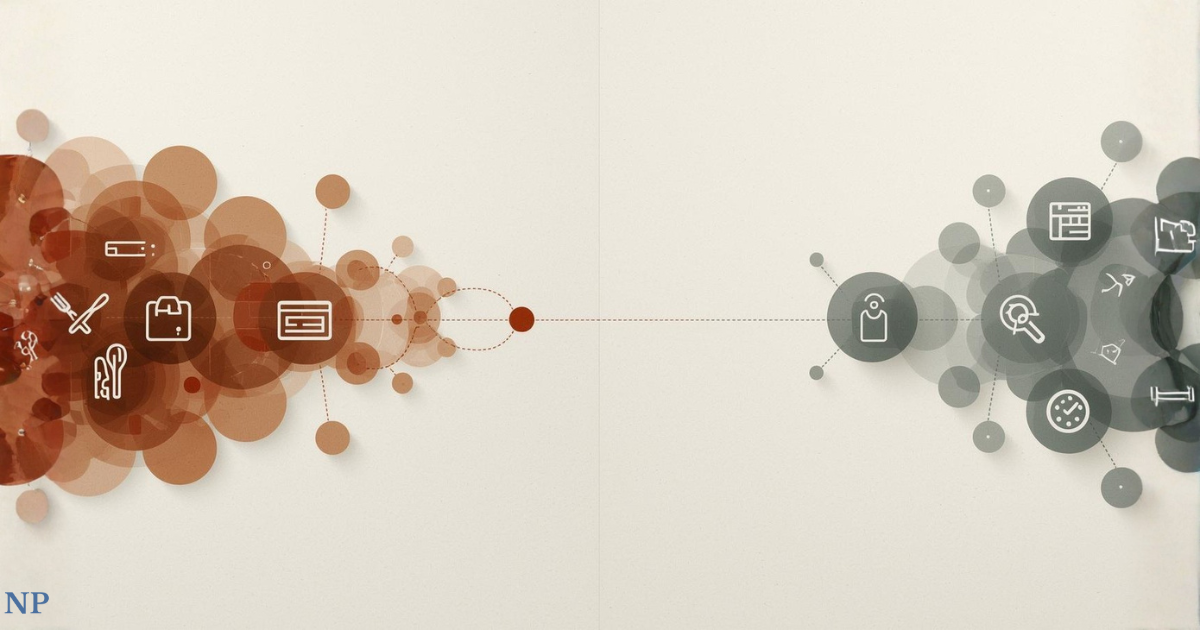
I raise my coffee on my conference call. She sips her soy milk on her commute. Two women at the same age and stage of life, beginning our mornings in different languages—one in English, one in rapid-fire Mandarin—yet living parallel equations: caring forward and caring backward, without a pause long enough to take a real breath.
We are separated by an ocean, but at 7:00 a.m., we live the same story in different accents.
Two Generations Forward, Two Generations Back
It turns out we’re not alone in our parallel lives.
In the United States, about 18% of millennials—adults born between 1981 and 1996—live in multigenerational households (1). But even that number doesn’t capture the full scope: over half of U.S. adults live within an hour’s drive of extended family (2). Proximity has become both a practical necessity and a quiet inheritance—driven by caregiving needs, financial tradeoffs, and the gravitational pull of familiarity.
Then there’s the other half—those of us whose parents live far away. About one in five young adults in the U.S. move more than 100 miles from their hometown by their mid-20s (3). For highly educated professionals, the odds of staying close to family shrink even further—only 42% of postgraduates live near relatives (2). For immigrant families or those navigating careers in global cities, caregiving often becomes a transnational responsibility carried by text messages, wire transfers, and the hope that technology can substitute for presence.
Globally, these stories multiply and diverge. In Croatia, Greece, and Italy, up to 77% of young adults live with their parents, compared to just 17% in Sweden and Denmark, where robust social safety nets reduce reliance on family-based care (4). In India, 76% of older adults live with at least one of their children (5). In Japan, more seniors now live alone as cultural norms shift. Geography changes the backdrop, but the plot remains familiar: the middle generation is stretched thin.
This isn’t just a phase. It’s a demographic inevitability. Millennials are raising children later and supporting parents longer. With fewer siblings to share the load, the caregiving weight isn’t just growing—it’s concentrating. Unlike our parents, many of us won't inherit a village. We are the village, in duplicate.
Parallel Loads, Diverging Pressures
My cousin and I carry our caregiving in different containers, but the weight—and the meaning—often overlap.
For her, help is just around the corner. Living just blocks from her in-laws means they’ve been there since her daughter’s birth—ready to step in for daycare, pickup when work runs late, or drop off a warm meal on a weekday. There’s an ease in the built-in safety net—a comfort in knowing that family is woven into the rhythm of every day. But that closeness also comes with constant negotiation: of space, of boundaries, of whose needs take priority. Sometimes, support is indistinguishable from obligation.
For me, the distance gives room to breathe. I parent on my own terms. I choose how and when to show up. But that autonomy is a double-edged blade. There are the recurring conversations about planning a date night—conversations that always end with us giving up, because there’s no one we trust to watch the kids. Then there’s the constant worry about not being physically around my aging parents. When something goes wrong, I’m not five minutes away. I’m a 14-hour flight, a last-minute scramble of work schedules, a different time zone away. My caregiving lives in the space between planning and helplessness.
Across both versions, the strain is real—but so are the moments of grace.
The Math, the Work, the Toll
Financially, the math rarely adds up neatly. Between child care, elder care, health expenses, and daily living costs, many of us are stretching the same paycheck across three generations. My cousin’s multigenerational setup eases some of the pressure—shared housing costs, built-in child care, meals cooked by many hands. But she also shoulders quiet expenses: covering prescriptions, grocery top-ups, small emergencies that add up.
From afar, my expenses show up differently: higher childcare costs without family nearby, remote caregiving services, international flights, cross-border shipping. Nearly 29% of middle-aged Americans support both parents and children financially (6), but the spreadsheet doesn’t capture the invisible costs—the quiet planning for the day when my parents can no longer live on their own.
Still, caregiving has a way of making our budgets more intentional. We learn what’s essential, where help is needed most, and how to stretch resources with the kind of creativity that only caregiving requires.
Professionally, caregiving can feel like a constraint—but it’s also reshaping what ambition looks like. My cousin’s decision to stay close to family meant turning down higher-paying opportunities in bigger cities, but it’s also given her a kind of stability: a shorter commute, a reliable support system, and a work-life rhythm that feels sustainable.
Like many others, I chased a dream school across an ocean, moved from city to city for jobs, and eventually built a life on the other side of the world with my own family. I’ve become a logistics strategist by necessity—juggling two time zones, syncing calendars across continents, and planning every family visit like a military operation.
Neither of us works less hard—we just work around the edges of care. And for many millennials, caregiving becomes more than a challenge; it becomes a catalyst. It nudges us toward more meaningful work: education, advocacy, health care, community-building. It doesn’t shrink ambition. It redefines it.
Emotionally, the toll is harder to quantify. There’s the wear-and-tear of always being needed, of waking up to new to-do lists that belong to other people. My cousin feels the slow erosion of personal time—stolen minutes between errands and requests. I feel the dissonance of distance: the ache of not being there, the guilt that blooms with every delayed reply or missed milestone.
But then there are the glimmers. A preschooler’s artwork proudly handed to a grandparent across the kitchen table. A text from my dad that says, "Thanks for the toothpaste—my gums finally stopped bleeding." The unspoken closeness that comes from being the one your parents still call first.
Yes, we are stretched. But we are also trusted. We are the ones holding the center—sometimes frayed, sometimes quietly proud.
When the Margin Vanished
The caregiving landscape has always been demanding—but the years since COVID-19 have reshaped it entirely. For both proximate and remote caregivers, 2020 marked the start of a prolonged crisis. And in 2025, the reverberations are still amplifying.
Financially, the cost of care has surged. Between 2022 and 2024, in-home eldercare costs in the U.S. rose by nearly 19.5%, far outpacing general inflation (7). Remote caregivers face stacked costs—long-distance travel, coordination services, cross-border care arrangements. Proximate caregivers absorb more direct daily costs: transportation, food, shared bills. In both cases, budgets are stretched across multiple roles with limited structural support.
Career-wise, over half of sandwich caregivers report that their responsibilities have negatively impacted their work performance or advancement (8). Many reduce hours or decline promotions; others leave the workforce entirely. Employers often penalize caregiving in implicit ways: visible caregiving is seen as distraction, invisible caregiving as disengagement. Remote caregivers may appear more available but often manage behind-the-scenes crises with no recognition. Proximate caregivers are more visibly interrupted—and disproportionately women.
Emotionally, the cumulative effect is burnout. Nearly one in four multigenerational caregivers in the U.S. report feeling "stressed most or all of the time" (9). The pandemic blurred boundaries, stretched expectations, and accelerated aging-in-place preferences, leaving family members—especially millennials—responsible for more complex care with fewer resources. The result? Exhaustion that’s no longer temporary. It’s structural.
The Road Forward
The sandwich generation is no longer a phase—it’s becoming a permanent feature of adult life. For millennials entering their 40s, the years ahead promise more complex care, longer responsibilities, and fewer traditional support systems. But they also hold the potential for meaningful change.
Demographically, caregiving demands are intensifying. By 2030, all Baby Boomers will be 65 or older (10). Millennials are caring longer and often for more than one generation at a time, while raising younger children and navigating dual-income households. Smaller families mean fewer hands to help.
Institutionally, responses are beginning to surface. Some employers now offer caregiver leave, dependent care stipends, or flexible schedules. A few states are piloting direct payments to family caregivers. In Europe and Asia, hybrid eldercare models and tax incentives are being explored. The momentum is growing—but uneven and fragile.
Technologically, there is cautious optimism. Smart pill dispensers, video check-ins, AI-coordinated calendars, and fall detection systems are quietly becoming part of everyday caregiving. These tools don’t replace presence—but they soften its absence. They make the impossible feel slightly more doable.
Culturally, the frame is shifting. Caregiving is no longer viewed solely as a pause or disruption. It’s becoming a throughline—a defining experience that reshapes ambition, identity, and connection. Millennials, raised on crisis and connectivity, are teaching a new language of showing up: not defined by geography or perfection, but by persistence and reinvention.
So what does this look like in 2025—for me, the sandwich generation 2.0?
It looks like a summer flight to China so my kids can see their grandparents and I can bring my mom to climb the Great Wall together. It looks like spring break in New York—because my older son loves the Statue of Liberty, the rainbow bagels, the Broadway Bubble show. Christmas in Cancun—because my younger one dreams of winter sun and endless sand. A final road trip to Canada, where my in-laws greet us with Cantonese pork bone soup and homemade hotpot to close the year.
It’s logistics as love language. Spinning calendars, syncing school breaks, budgeting across borders—because that’s how I show up.
Not perfectly. But fully. With tired hands, an open calendar—and deep thanks that I still can.
Endnotes
(1) Pew Research Center, "The Growing Number of Multigenerational Households," 2021.
(2) Harvard Joint Center for Housing Studies, "Family Proximity and Intergenerational Support," 2023.
(3) U.S. Census Bureau, "Geographic Mobility Trends," 2022.
(4) Eurostat, "Young Adults Living with Parents," 2021.
(5) United Nations Population Division, "Living Arrangements of Older Persons," 2022.
(6) AARP, "The Cost of Caring: Out-of-Pocket Spending by Caregivers," 2023.
(7) KFF, "Home Health Costs Outpacing Inflation," 2024.
(8) Rosalynn Carter Institute for Caregivers, "Working While Caring," 2023.
(9) Pew Research Center, "Caregiving and Stress Levels in Multigenerational Households," 2022.
(10) U.S. Census Bureau, "2020 Census and Population Projections," 2021.