
Forgotten Closets and Forgotten 401Ks - Making sense of why we chase bargains, dodge futures, and spend the way we do
Promo codes sparkle brighter than balance sheets. We hunt discounts on kids’ snacks yet ignore our 401Ks, fill closets with “affordable luxuries” while the future sits in silence. Three forces explain it all: Feel, Self, and Time.
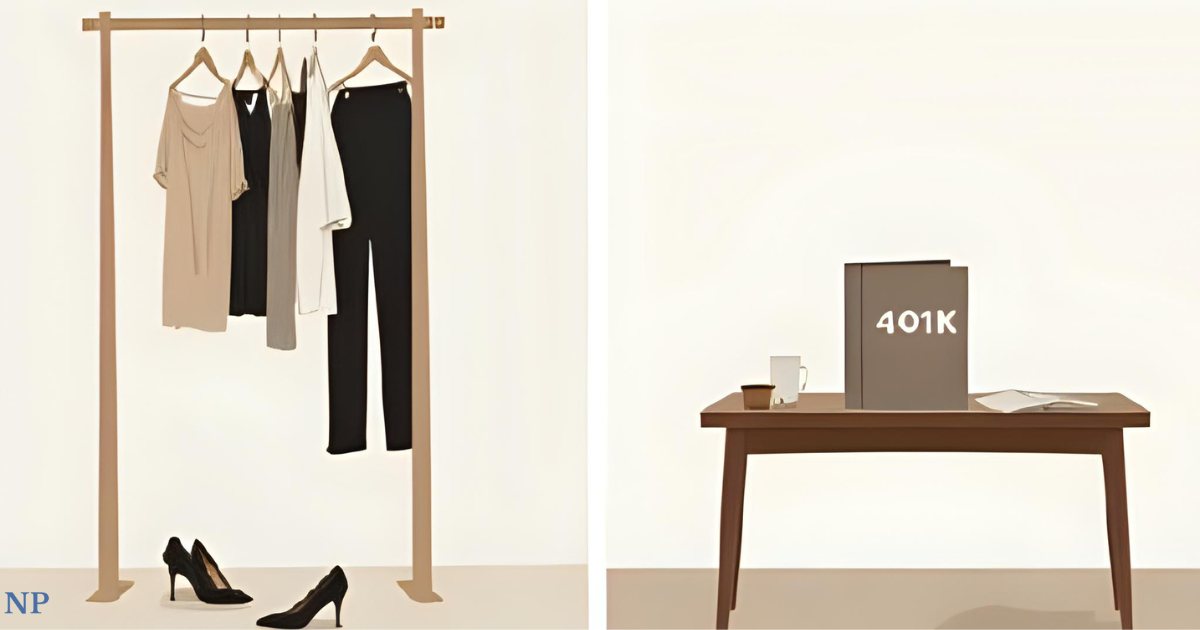
I like to think of myself as a logical person. Rational, measured, the type who reads reviews before buying anything. But when it comes to spending, my logic has a way of slipping out the side door. I’ll spend hours hunting down the “best deal” online, determined to save five dollars, but go months without lifting a finger to check my 401K allocations.
I rarely bother driving to the mall — it takes sophisticated planning, juggling family activities and carving space in an already packed schedule. But I shop on Amazon all the time, because it’s that easy: one click, free shipping, free returns. And yes, I’m the kind of self-proclaimed penny pincher who squeezes coupons at the grocery checkout, yet I’ll splurge on “affordable luxuries” — another pair of Lululemon leggings or Stuart Weitzman heels that catch my eye in the moment but end up forgotten in my closet, tags still on, while I reach for the same yoga pants and block pumps on repeat.
If this looks irrational, it isn’t random. Behavioral science would say I’m playing by rules that are written into all of us. Three forces, in particular, run the show: Feel, Self, and Time.
FEEL — The Loud Bargain and the Quiet Cost
The bargain is loud; the cost is quiet. Economist Richard Thaler called this transaction utility³: the spark of joy that comes not from owning a thing, but from the deal itself. Coupons and discounts light up our brains the way a slot machine win does, which is why shaving five dollars off kids’ snacks feels like a triumph.
And retailers know it. Frictionless design makes it nearly impossible to resist: one-click checkout, saved cards, curbside pickup. Every little obstacle that used to slow us down — finding a wallet, typing a number, waiting a week — has vanished. Even risk friction has disappeared: “free returns” assure us that no choice is final.
Evidence shows just how effective this is: shoppers spend more when using contactless cards than with cash, because the “pain of paying” is dulled⁴⁵. Buy now, pay later plans amplify it further — in 2023, nearly one in four U.S. adults used BNPL, often juggling multiple plans at once¹.
Historically, this is a dramatic shift. For my grandparents, thrift was a moral virtue — a winter jacket was a lifetime investment, passed from the oldest to the youngest as a treasured hand-me-down. Today, bargain-hunting has morphed into a hobby, gamified by apps and browser extensions. Thrift has drifted from necessity to entertainment.
Provocation: How many of us could still live with only one jacket, in a world where every season — and every holiday — arrives with another sale?
SELF — The Identities We Buy
Even if we dodge the retail traps, most of us still have our non-negotiables — the things we insist on buying, no matter how irrational they look on paper. These aren’t about utility; they’re about identity. Economists call this identity economics: we don’t just spend money, we spend selves.
A pair of Lululemon yoga pants doesn’t just say “athleisure” — it says I’m still the kind of mom who has her act together at the gym. The Stuart Weitzman pumps in the closet? Less about leather, more about the polished professional I imagine when I see them on the shelf. The drawer overflows because the real payoff isn’t wearing the item; it’s owning the story.
Psychologists have found that people are more likely to buy luxury goods when their sense of identity is threatened⁶ — insecurity fuels status consumption. And it isn’t universal: in the U.S., buying often signals ambition or success, while in Japan, brands like Muji sell the opposite — minimalism as identity. Even non-consumption becomes a cultural badge.
Provocation: If identity is what we’re buying, then who’s really in charge — us, or the brands writing our stories for us?
TIME — The Future That Doesn’t Sparkle
And then there’s the quiet giant: the future. The biggest “spending” in my life isn’t a shopping cart at all — it’s the steady drip into my 401K. Over decades, those contributions will decide whether my eighty-year-old self lives with comfort or constraint. And yet, I avoid it.
Behavioral economists call this present bias: our tendency to privilege the immediate over the eventual. A coupon glitters today; a retirement allocation barely flickers. Research shows that Americans are far more likely to search for online coupons than to adjust their retirement portfolios, even though a single 15-minute rebalance could outweigh years of couponing⁷. Nearly half of U.S. workers cannot state their 401K balance within $10,000⁸, yet most of us can recall our monthly subscription charges to the dollar.
The cultural backdrop has shifted too. In the mid-20th century, saving was framed as patriotic in the U.S.: war bonds, pensions, “pay yourself first.” Today, the personal savings rate hovers around 4–5% — low by historical standards, despite a brief pandemic spike into the mid-20s⁹. Looking abroad, the pull of instant gratification is growing even in cultures built on saving. In 2023, China’s Singles’ Day racked up a staggering $156 billion in sales¹ — yet the country’s household savings remained around 34% in 2022².
Provocation: From the West to East Asia, our societies have subtly shifted from celebrating the future to exalting the flash sale. Next time you’re on a long flight, try asking your neighbor what’s on sale — it might be the only global language we all speak.
My Verdict
Spending, it turns out, is less about arithmetic than attention. Where our minds go, our money follows — toward the glitter of a coupon, the story stitched into a brand, the ease of a click. The danger isn’t that we’re irrational; it’s that we’re predictably human.
The real question is: who profits from that predictability? When bargains drown out balance sheets, when brands ghostwrite our identities, when coupon codes sparkle brighter than compound interest — maybe the task isn’t to outwit every retail trick or to shame every splurge, but to choose the rhythms worth keeping. Because in the end, the challenge is not just where our money goes, but where we find ourselves in the noise.
Endnotes
- Singles’ Day Statistics 2023. Queue-it. Link.
- World Bank Data (2022). Gross Domestic Savings (% of GDP), China.
- Thaler, R. (1985). Mental Accounting and Consumer Choice. Marketing Science.
- Prelec, D., & Simester, D. (2001). Always Leave Home Without It: A Further Investigation of the Credit-Card Effect on Willingness to Pay. Marketing Letters.
- Raghubir, P., & Srivastava, J. (2008). Monopoly Money: The Effect of Payment Coupling and Form on Spending Behavior. Journal of Experimental Psychology.
- Han, Y. J., Nunes, J. C., & Drèze, X. (2010). Signaling Status with Luxury Goods: The Role of Brand Prominence.Journal of Marketing.
- Benartzi, S., & Thaler, R. (2007). Heuristics and Biases in Retirement Savings Behavior. Journal of Economic Perspectives.
- Employee Benefit Research Institute (2023). Retirement Confidence Survey.
- U.S. Bureau of Economic Analysis (2023). Personal Saving Rate Data.