Algorithms in the Bedroom - what happens when the tools that once bridged distance now curate our attention, and even compete for our intimacy
From Skype bridging oceans to smartphones building bubbles, technology has reshaped intimacy. We may sit inches apart yet scroll worlds away. This essay traces the shift from bridge to bubble to third presence—and what it means for love.
I have a love–hate relationship with technology in my marriage. Back in college, when my husband and I were an ocean apart, I carried my laptop across campus like an extra limb just to keep a Skype window open. Twelve time zones and a continent shrank to a rectangle of light; we were far in miles, but he felt close through the screen.
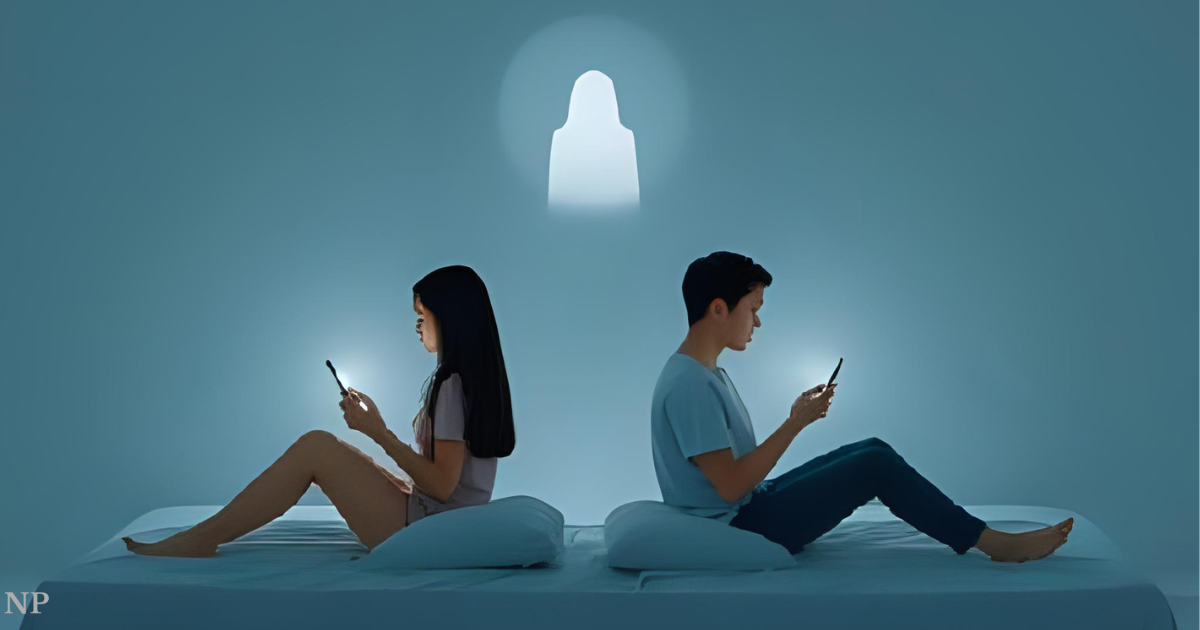
Fast forward to now: we can sit at the same dinner table, inches apart. Our minds are miles away, each scrolling on our phones, absorbed in completely different worlds.
It makes me pause: what has shifted? Is it simply that the tools have become sleeker, more portable, harder to put down? Or has the role of technology itself changed—from drawing us closer, to enclosing us in separate bubbles? And if so, what might come next?
The Bridge — Mediators That Moved Us Closer
Long before laptops, couples leaned on technology to bend distance. In the eighteenth and nineteenth centuries, love letters were often the only tether across weeks or oceans. John and Abigail Adams exchanged nearly 1,200 letters while separated during the Revolutionary War, describing them as the most sustaining part of their days¹. Ink carried presence when presence wasn’t possible.
By 1876, Alexander Graham Bell patented the telephone, and within two years some 49,000 phones were in use across the United States². The telephone collapsed time and geography into a live voice—laughter, pauses, even silence could be shared in a way no letter could capture. By the mid-twentieth century, landlines were as common as plumbing: 45% of U.S. households had one in 1945, 75% by 1957, and over 90% by 1970³. The voice at the other end of the line became part of daily life for couples separated by work, war, or travel.
By the 1990s, the bridge stretched further. The internet carried not just voices but faces. Messaging platforms like ICQ and AOL Instant Messenger let couples type in real time, complete with “away messages” that stood in for presence⁴. By the early 2000s, webcams and services like Skype (launched in 2003) made it possible to see a partner across continents. For long-distance couples, this was revolutionary: you could eat dinner “together,” fall asleep on video, or keep a window open for hours as if you shared the same room. What letters and phone lines only hinted at, the internet made visible—presence, mediated but tangible.
The Bubble — Mediators That Pull Us Apart
Today, the same devices that once promised connection often carve out distance—thanks to the smartphone, which accelerated this shift at breathtaking speed. The iPhone debuted in 2007; by 2011, more than half of U.S. adults owned one⁵. By 2021, that figure had climbed to 85%⁶. With adoption came immersion: Americans now spend an average of 4 hours and 25 minutes per day on mobile devices⁷. The bridge that once collapsed oceans now collapses hours, funneling those hours into screens. But instead of joining couples in the same space, smartphones often create bubbles—each person absorbed in a personalized feed, inches apart yet worlds away.
Behavioral researchers call this “phubbing”—snubbing someone in favor of a phone. It’s more than a small annoyance: studies show that phubbing is linked to lower relationship satisfaction and more frequent conflict between couples⁸. Even casual interruptions—the mid-conversation glance at a notification—signal that attention is elsewhere, that the partner in front of you has been displaced by something more urgent, or at least more enticing.
The scale of this attentional drift is staggering. Americans check their phones an average of 144 times per day, and nearly 70% say they use them during meals⁹. Among couples, over half admit to being distracted by their phone while spending time together¹⁰. The device that once collapsed oceans now creates micro-gaps at the dinner table and in bed.
Unlike letters or phone calls, today’s mediators don’t just transmit; they curate. Algorithms personalize what we see, narrowing exposure and reinforcing our own viewpoints—a phenomenon Eli Pariser dubbed the **“filter bubble”**¹¹. That’s why my husband has joined the cult of Mr. Maple—his feeds now filled with rare cultivar groups—while mine are dominated by Caroline Girvan workouts and fitness content. Harmless hobbies, maybe. But when algorithms tug us into separate worlds, even our daily conversations shrink to a single essential: what’s for dinner?
The Third Presence — Mediators That May Join Us
If the past was about bridges and the present about bubbles, the future may be about something stranger: a third presence in our relationships. Already, algorithms nudge us—suggesting the text reply, finishing our sentences in email, recommending the date-night restaurant. These aren’t neutral tools; they are beginning to mediate not just how we connect, but also when and what we say.
Emerging technologies hint at how far this might go. AI chatbots designed for companionship are gaining traction, with some users reporting emotional bonds that rival human ones¹². Virtual and augmented reality platforms are experimenting with simulated intimacy, allowing couples separated by geography to “share space” through headsets¹³. And relationship apps now offer features that remind partners of anniversaries, prompt gratitude messages, even coach conflict resolution in real time¹⁴.
I’m not a sci-fi fan, but I vividly remember the heartbreak in the 2013 film Her, when a lonely man falls in love with his AI operating system—only to discover that his “partner” is simultaneously having thousands of other conversations, even romances. What struck me wasn’t the betrayal, but the realization that our limited attention is what makes us human. A relationship is, at its core, the decision to dedicate that attention to one another—and no algorithm can truly stand in for that.
My Verdict
What makes a relationship isn’t the tool—it’s the attention. A love letter carried across oceans, a phone call that cuts through silence, even a late-night video chat: all of them only matter because someone chose to be present on the other end.
That’s what the devices of today—and the algorithms of tomorrow—can never guarantee. They can amplify, distract, or even impersonate, but they cannot give what is most human: the decision to notice, to listen, to give our finite attention to one another.
And yet, I keep my optimism. There could be a world where AI serves as a mirror, nudging us toward kindness when we’re distracted or prompting connection when we drift. That future isn’t inevitable—it depends on what we choose to protect.
Endnotes
- Hogan, M. (2014). The Letters of John and Abigail Adams. Library of America.
- Fischer, C. (1992). America Calling: A Social History of the Telephone to 1940. University of California Press.
- U.S. Census Bureau (1975). Historical Statistics of the United States, Colonial Times to 1970.
- Campbell, S. W., & Park, Y. J. (2008). Social implications of mobile telephony: The rise of personal communication society. Sociological Compass, 2(2), 371–387.
- Pew Research Center (2011). Smartphone Adoption and Usage.
- Pew Research Center (2021). Mobile Fact Sheet.
- DataReportal (2023). Digital 2023: Global Overview Report.
- Roberts, J. A., & David, M. E. (2016). My life has become a major distraction from my cell phone: Partner phubbing and relationship satisfaction. Computers in Human Behavior, 54, 134–141.
- Reviews.org (2023). 2023 Cell Phone Usage Statistics.
- Pew Research Center (2020). Americans and Digital Distraction.
- Pariser, E. (2011). The Filter Bubble: What the Internet Is Hiding from You. Penguin.
- Ta, V. P., Esperanza, J., & Stojanovic, M. (2023). The allure of AI companions: Exploring the rise of chatbot relationships. Frontiers in Psychology.
- Bailenson, J. (2018). Experience on Demand: What Virtual Reality Is, How It Works, and What It Can Do. W.W. Norton.
- Bonior, A. (2019). The Friendship Fix: The Complete Guide to Choosing, Losing, and Keeping Up With Your Friends. Simon & Schuster.